
We should be sincerely grateful and seriously motivated to embrace God’s powerful and life-changing word to us!
Downloads
Sermon Transcript
Speaking of my family, I remember when we had just had our third child. Stephanie was born, and your third child, you know, it’s something. It’s when they finally outnumber you, and you’re feeling that sense of despair that you’re in trouble here.
I remember we went out to go buy a new minivan. Figured that might help us feel better and transport all these kids around. I remember we did the research and we discovered the one that we wanted. We soon realized it was the one that everyone wanted because nobody had one. Every dealership we called didn’t have one in stock. We waited patiently.
Finally, we got a call from a local dealer over here. He says, “I got one in. It’s here. I don’t know if you’re going to like it because it’s not the model that you want.” He said, “It’s the model above the one you were looking for.” Oh, darn. He said, “It’s got one of those fancy GPS things in the dashboard.” So I thought, well, you know, a few extra bucks a month. Okay, it’s the only one I can find out. We’ll take it.
So we drove this thing home with this dashboard GPS. And I know a lot of you have one of those. First time I’d ever had one. And I remember thinking, you know, guys, a special thing—who needs one of those, right? We know how to get around.
Well, I must confess, though we rarely do confess this, I was thrilled after about two weeks of having this inboard, you know, dashboard GPS. Got rid of the Thomas Brothers. We were so excited. And we just thought, this is it, the way to go.
And, you know, about, I don’t know, a few years down the line, we just stopped being so excited about the GPS. And it wasn’t because we didn’t utilize it. It wasn’t because we didn’t rely on it. It was because, like, with a lot of things you get used to, we began to take it for granted.
Well, God fixed all that about a month ago when I was up at a pastor’s conference, and they actually had this conference in a place where there’s less signage and more twisted and contorted roads than Orange County, believe it or not. And I must have reached for the dash about 20 times to turn on the GPS, which, of course, my rental car didn’t have.
And boy, I tell you, there are so many times I just prayed for one of those GT1 miracles for one of those GPS to pop on the dashboard. I was lost without it. I couldn’t handle it. I couldn’t stand it. And what was funny is all of us pastors, we were carpooling and no one knew where they were going. And we were hopelessly lost working through these winding streets and every other street didn’t have a sign on it. It was a complete and total disaster.
Well, I realized when I came back home, got picked up at the airport, saw my wife’s van and there was the GPS, how grateful I was for that. And I found that it’s a lot like a lot of things. You know, we just learn to depend on and rely on things, and then sometimes we just forget how important they are to us.
Scripture is much the same way. We have, from God, in our laps, every Bible-carrying Christian in this building right now has God’s direction for life right there in your lap. Tells us where we’re at, tells us where we should be, and tells us how to get there. It is God’s clear and direct satellite-guided, if you will, directions for our lives. And we’re so used to having it, I think a lot of us fail to appreciate it the way that we should.
All you have to do is do a little research, go on websites like the Wycliffe Bible Translators and find out that half of the languages in the world don’t have the Bible in their own language right now. There’s over 380 million people, their website says, that have yet to see a single verse of the Bible in their own language.
Or take yourself back in time and think about how many generations in church history didn’t have access to the Bible. If you wanted to know what God’s word said or you wanted direction from God, you had to work through the leaders of the day. You had to work through the priests and the church bishops and so forth who were very particular about who got a copy of God’s word. And with twisted motives mixed into the equation, you a lot of times had people—you weren’t going to get a clear statement of what the Bible said through the leaders. And a lot of generations of Christians would long for what you have right now. A Bible sitting in your own language, sitting on your lap, directives from God.
It’s an amazing thing that we have. We’re tremendously blessed. And what we need to do, I think, is to step back and say, what an amazing thing that we have the codification of God’s mind on paper. It’s there for us. It’s available to us.
But much like the GPS, you can have it, but it’s no good to you unless you reach over and turn it on. And, you know, that’s the problem with us Christians. We may have one. We may have multiple copies. Most of you do. And yet the question is, how often are we looking to that thing, God’s living word, and saying, I need that. I’m going to get into that. I’ve got to take that off the shelf, and I’ve got to ingest this into my life so that I can have God’s divine direction for life.
It’s important that we do that, and I think Hebrews chapter 4, verses 12 and 13, couldn’t be any better passage in all of Scripture to remind us how important God’s Word is and then to be motivated by the importance of it to get into it, and I hope that this week you find yourself enthusiastically drawn to God’s Word more so than you were last week.
So let’s open up our Bibles one more time. The last time for a while, we’ll open to Hebrews chapter 4. And I know we looked at this passage briefly last week, but we had to hit the pause button, come back to this great set of verses and words and phrases about God’s word. And we need to look at it and ingest each part of it.
And so to do that on your worksheet, hopefully you found that, I have a junior chart. It’s not really a chart. It’s not on the magnitude of a Thursday night chart, but it’s a small chart and it looks something like this on your worksheet. Two sides to this, God’s Word and God. Verse 12 tells us about God’s Word. Verse 13 tells us something about God. And I think as you’ll see in this text, they go nicely together to make a very strong point about our relationship to God’s Word.
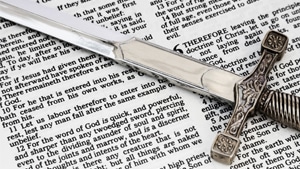
Let’s read the text. It starts in verse 12 by saying, the Word of God is living and active. It’s sharper than any double-edged sword. It penetrates even to dividing soul and spirit, joints and marrow. It judges the thoughts and attitudes of the heart. It’s all about God’s word.
Now look at verse 13. Some information about God now. Nothing in all creation is hidden from God’s sight. Everything is uncovered and laid bare before the eyes of him to whom we must give an account.
Now if you take a look at that chart, we’re going to look at the three words that describe God’s word, that it’s living and active, and then it says in this metaphor that it is sharper than any double-edged sword. We’re also going to look at some of these phrases about God in verse 13, that nothing is hidden from his sight and that everything is uncovered. We’ll make note of the inference that’s put right in front of us by talking about creation, that we’re a part of God’s creation. And then lastly, that last phrase that we must give an account.
So if we can, we’ll work from the outside of this chart to the middle to try and understand what God is having us value about God’s word.
That word there, living, of course, is a word that is in contrast to dead. You might think, well, you know, I don’t know any books that are dead. All these books seem about the same, but I think if you gave it a little thought, you would recognize that some books are simply dead to you, and other books are very much alive to you.
We’ve got the great news in the office that we celebrated not long ago that my longtime assistant, Maggie Jones, is expecting her first child after years and years. So, of course, I’m the guy who likes to give books, but I went to my library, didn’t have any books that would help her, so I said, let’s go down to the bookstore.
So we drove right over here to the big bookstore. We walked in the bookstore, we got one of those baskets, and I just started loading up all these books. And what I realized is I went up to the counter to pay for these books, as I was going to give them to Maggie. The gal looked at me, and of course, I realized none of these books had any applicability at all to my life. What to Expect When You’re Expecting has, I mean, it’s a book that’s dead to me, let’s just be honest. It never has, does not now, nor ever will have any applicability to my life. It’s, you know—she looks at me funny, and I had to say, “It’s for her,” right? All these books on motherhood and children and pregnancy.
Now, to Maggie, they’re very much alive. As a matter of fact, you find if you had those books or had access to some of those books when you gals were pregnant, I mean, that just becomes very, very much alive to you. It becomes alive to you because it’s relevant. It has something important to say to you.
See, in scripture, it’s being described here as something living. Here’s a word I’d like you to put in that box next to the word living. What we mean by that, of course, it’s a metaphor. It doesn’t move across the table on its own. It doesn’t move from the bookshelf to your car if you forget. It’s sense that God’s word is relevant to you. It’s relevant to you.
Now look across to verse 13, because God is a God who sees everything. Nothing in all creation is hidden from God’s sight. Everything is uncovered and laid bare. See, God is a God—in statements like nothing hidden and everything uncovered—is what we call in theology, God is omniscient. He knows all things. And to be specific, he knows all things about you and he knows all things about me.
Now take a look at those two together. Why is God’s word alive to us? It’s alive to us as people because God is a God who’s writing it to us and he knows all about us. And what’s true about me and what’s true about you is explained and described and it is a message that is designed specifically for us. You can’t get away from that. As a matter of fact, just above point number one, jot down those two words again. God’s word is relevant because God is omniscient. It’s important to you as a relevant book because God has written it to you and he knows all about you.
Therefore, when it comes to God’s word, we need to, number one on your outline, we need to approach God’s word, we need to approach the Bible as applicable.
I don’t know how many times you’ve been confronted with folks that want to teach the Bible or maybe classes in college or even high school where they like to talk about the Bible as literature. Have you taken a class like that? There’s ways to look at the Bible where you approach the Bible as history. Learn about ancient Mesopotamian kings or Babylon or Assyria or Tiglath-Pilesar or the pharaohs of Egypt or whatever it might be, and it becomes a textbook of information.
But God’s word is living, the scripture says, because God is a God who looks at us and knows everything about us, and he’s got something to say to us. And in that sense, the Bible is not some objective thing that we can just look at as a list of facts and information. It is for us as people recognizing this book comes from God. It’s very much applicable to my life. It’s alive because God knows everything about me.
Take a look at this text. If you keep your finger in Hebrews 4, turn with me to Psalm 139. Psalm 139. It’s a classic text. And if you haven’t read it lately, perhaps it can help you. Remember how intimately God has said as an omniscient God that he knows us.
Here’s the declaration in Psalm 139. It’s a psalm credited to David. King David says these words beginning in verse number one. Psalm 139:1: “O Yahweh, you have searched me and you know me.” Look at the poetic way he describes this: “You know when I sit and when I rise; you perceive my thoughts from afar. You discern my going out and my lying down; you’re familiar with all of my ways. Before a word is on my tongue you know it completely, O Lord. You hem me in behind and before; you’ve laid your hand upon me. Such knowledge is too wonderful for me. It’s too lofty for me to attain.”
It’s a good place for us to be. Are we really amazed at the fact that God has us completely wired? He knows everything about us? Matter of fact, if you wanted to hide from God, you couldn’t.
Verse 7: “Where can I go from your spirit? Where can I flee from your presence? If I go up to the heavens, you’re there. If I make my bed in the depths you’re there. If I rise on the wings of the dawn, if I settle on the far side of the sea,” said, “even there your hand will guide me and your right hand will hold me fast. If I say surely the darkness will hide me and the light will become night around me, even the darkness will not be dark to you. The night will shine like the day for darkness is as light to you.
“For you created my inmost being and you knit me together in my mother’s womb. I praise you because I’m fearfully and wonderfully made. Your works are wonderful. I know that full well. My frame was not hidden from you when I was made in the secret place. When I was woven together in the depths of the earth, your eyes saw my unformed body and all the days ordained for me were written in your book before one of them came to be. How precious to me are your thoughts, O God. How vast is the sum of them.”
It’s amazing, the psalmist says. It’s amazing that God knows us intimately. And Jesus comes on the scene and affirms the same thing. He says there’s not a bird that falls out of a tree that God doesn’t know about and ordain. And then he goes on to talk about every hair on the top of our head is numbered.
Scripture is presented to us as a message from someone who knows us intimately. And though you’re not going to find your name or your street address in this book, the Bible is written to people just like me and you. And I think we start to isolate ourselves in our own mind thinking, you know, I’m so much different than everybody else. And you’re not.
Everything that David needed was given to him in God’s word. And everything that you and I need and all the commonalities of our struggles and our hurts and our fears and our temptations, God says, I’ve addressed those in a book. And he’s got a book presented to us, and he says it’s applicable to you. And the knowledge and a message, it makes all the difference.
Even if you might say, well, I know the Bible is relevant and I should do it, if you’re not completely immersed in the understanding that God knows everything about you, there’s still a distance that you can put between God’s word and you. And it won’t be fully living because you think, well, I know God wrote this and I know it’s applicable to me, but you know what? I’m just not going to pull it closely.
You won’t pull it closely and feel the same conviction unless you know that God has you in mind and he knows you intimately. It’s the difference between Arnold Schwarzenegger’s—when he was on the Presidential Council for Physical Fitness. Do you remember when he did that? And out went the proclamation that all you guys are lazy and you all need to be strong and fit like me, right?
Now, I remember hearing that from Arnold, and I must admit, I realized that that was relevant to my life and was applicable to me, see? But it doesn’t have the same effect as if my wife were to walk into the bedroom and say, “Hey, you’re lazy,” you know? “You’re fat,” you know? “You need to work out,” you know?
If my wife says that, the sting and pain of that conviction—it’s strong and lasting. Now what’s the difference? Arnold can write it on very official presidential stationary saying, “I’m the chairman of the presidential fitness committee,” and I know when he says you need to do so many sit-ups and pull-ups and push-ups and all that, I know I can say, well, that applies to me, see?
But when someone who knows me intimately and has seen me without my shirt on says I’m fat, that’s different, isn’t it? Boy, that feels different. Feels different because I know the one telling me that intimately knows me.
And when God opens up for you in the pages of scripture, the problems that you face as a human being, do not dare think that the infinite omniscient God didn’t know that you would be reading this someday and need to hear this. He wrote it for you. He wrote this book so that you would know it and that it would do something in your life.
See, the difference between my wife saying something about my weight and need for physical fitness and Arnold saying something about my weight and my need for physical fitness, I trust will be the difference between doing something about it and simply agreeing with it mentally. See what I’m saying?
That’s why underneath number one, at least jot this down. You need to make sure, if you want to test whether or not you see the Bible as applicable to you because of a God that knows you, you need to check whether or not it’s making a regular change in your life. If it’s not making any change in your life, then you really don’t see it as applicable.
But if you’re approaching God’s word every weekend at church, every weeknight at a Bible study, and every morning in your own time in reading God’s word, if you don’t approach it as a Bible that is applicable to your life, then you’re not going to see much change.
But if you approach it every morning saying, “God, I know that you know me. You left this book for me as a guide for my life. You gave me knowledge about you in this book. I need to know how that can change me,” see, then you’re going to go away and start to see a pattern of change in your life. And guess what? You’re approaching the scripture properly then. You’re approaching the scripture as an applicable book to you. Make sure it’s making a difference in your life.
Jeremiah is a frustrated prophet in many ways. I’d like you to turn to one passage in Jeremiah chapter 25. Reminds me a lot of Ezekiel 33, because Ezekiel had the same problem that Jeremiah had. Jeremiah 25, he refers to it. So does Ezekiel 33, as Ezekiel confesses that although I’m here giving God’s message, people aren’t listening to me.
Matter of fact, I love the way he says it in Ezekiel. He says it’s like I’m up here playing a nice song for people and they love the melody but they go away—and here’s how Jeremiah puts it—they don’t do anything about it. And he says that’s the problem. Prophecy and scripture is always applicable to life and if it doesn’t change me then I don’t understand it. I’m misunderstanding the purpose of it.
Look at Jeremiah, in Jeremiah 25. Are you there? Verse 3. And by the way, as you approach this text remember that God’s word to me is applicable to me for my good. It’s not that God is trying to do something bad in your life. He’s trying to do something good in your life. And if only Israel would have figured that out when Jeremiah was out there.
As a matter of fact, look at verse 3. “For 23 years,” Jeremiah says, “from the 13th year of Josiah,” he says, “until this very day, the word of Yahweh has come to me and I’ve spoken to you again and again, but you haven’t listened.”
Here’s a guy who’s been preaching to these people for 23 years. “And though Yahweh has sent all of his servants, the prophets to you again and again, you have not listened or paid attention.” Oh, they listened, but there was no listening to make a change in their lives.
Verse 5: “They said, ‘Turn now each of you from your evil ways and your evil practices, and then you can stay in the land that Yahweh gave you and your fathers forever and ever. Don’t follow the other gods to serve and worship them. Don’t provoke me,’ God says, ‘to anger with what your hands have made. Then I won’t harm you.’”
“But you did not listen to me,” declares Yahweh. “You’ve provoked me with what your hands have made, and you’ve brought harm to yourselves.”
Here’s a God saying, I’m speaking to you, I’m speaking to you. And people are listening, just like in Ezekiel 33, they’re listening politely, but they’re not doing anything about what they hear. And because of that, God’s word is nothing more for them than a beautiful song that’s played. And they go, that was nice. And they leave without any change in their lives.
Obviously, James chapter one, you’ve heard it hundreds and hundreds of times. God doesn’t want us to be hearers of the word only. He’d like us to be doers of the word. And if you pick up your Bible in the morning and you go, I’m just looking for information, you’ve missed the point. It should be there as a catalyst for change in your life because God has written it to you and he knows you intimately. And he knows what you need. And he’s codified it in the scripture.
It’s a great verse. Just jot it down. Psalm 19:9. Those great words about the scripture. Just remember that by your ordinances, your servant is warned, the psalmist says. And in keeping them, there’s great reward. You need to approach the Bible as applicable because what God is doing in those pages is something for your good. It may not feel good in the short term, but it’s for good in the long run.
God’s word is relevant because God is omniscient.
Okay, back to our chart. The second description in verse number 12 is that God’s word is not only living, it’s an active word. It is a document and information that is active. The Greek word is energes, energes. And I say that because if you transliterate it, it spells the word energy. We get the word energy from it. It is something that is powerful, something that gets in us and it works. It does something royal, something big. It’s an important word, a word that ought to move us. Now across in verse 13, the scripture also is quick to throw in a word that helps us remember the position of God over this universe.
He doesn’t just say that everything in the world is laid open before God. It’s not hidden from God. He uses a word that whenever you see it in the scripture, ought to remind you that the writer is trying to get you in perspective. And the word is, he says in verse 13, “nothing in all creation is hidden from his sight.”
Now we blow over that so quickly, we forget what it means. It means that God is our creator. Put this down in the box next to active. Active is a word that speaks of power, something large, something strong, something that works powerfully, and it works powerfully because God is a God who is in the position of boss of the universe, creator of the universe. He’s the manufacturer of all things.
Therefore, you can put in that statement above number two, God’s word is powerful because God is your creator. And when your creator speaks, it ought to be different than when everyone else speaks. And in that regard, his word is powerful. It’s big. It should be something we stop and take notice of. And everything else ought to get quiet when the creator speaks. And his word is a powerful word.
And you ought to, number two on your worksheet, you ought to approach it as authoritative. You don’t open the Bible as a book that’s just another opinion about how to raise children or how to live your life or how to do marriage or how to conduct your business. It’s not an opinion. This is not Tony Robbins’ book, right? This is God’s book. And God has spoken through the prophets and apostles and codified his instructions and they’re coming from your creator. And if you know who this is coming from, this is not just someone who knows you, but this is someone who has made you, then all of a sudden now the information becomes even more important.
And we ought to come with that respect for God’s word that gives me a sense that I’m reading an authoritative book. It’s a book from the manufacturer.
Speaking of new cars, grandma bought little Stephanie, who’s now three, bought her a Barbie Jeep, which I thought was all good and fine for her birthday, right? But the problem was it came in a box that was way smaller than it should have been. And I’m realizing this is, you know, this is dad’s work, right?
And so we took the box and we put it in the garage and we took all this stuff out. And my wife will tell you, she lamented over it for a while. I’m kind of busy. So I didn’t get to it as quickly as I wanted to. As a matter of fact, I felt the pang of guilt every time I went in the garage to get in my car, there was my daughter’s car in pieces. Because my boys wanted to help by clearing all the pieces out of the box, right?
So we had the whole thing just kind of laid out with all of its pieces everywhere in the garage. And so it didn’t matter. I was heading somewhere. I’m going to get in a couple minutes. And I’d get in a couple minutes, and I’d put a few pieces together. Well, you know what happened? It wasn’t too long until we finally misplaced the instructions.
And what was so interesting is to watch my two boys, right, seven and nine, filled with advice about how to put this car together. They’d pull out a piece and they’d say, “Dad, look at that piece. I don’t think we need that.” And boy, I was really tempted to follow their advice. There are so many pieces, I just said, no, I hope this doesn’t go anywhere on this thing. And yet, of course, I recognized those pieces fit somewhere. I just had no idea where.
But Stephanie’s two older brothers, boy, they were barking out all kinds of it. Finally, one day I said, I’m going to put this thing together. We’re going to put this thing together. I got time right now, and I’m going to do it.
My boys came in the garage, and there I was, pulled the toolbox out, and we were ready to go. Problem is, we couldn’t find the instructions. So we tore the garage upside down. We just pulled everything off, and finally found the instructions. And then what was so great is I could pull those instructions out and I could lay them on the floor next to all the pieces of the Barbie Jeep and I could say to my kids, my boys who still had all their advice, I could say, “Shut up. I’ve got the instructions right here. All I want you to do is keep your finger right on the step that we’re on and just keep us on track because your opinion no longer matters to me. I found the instructions.”
And here’s what I found out. Every piece went somewhere on the Barbie Jeep. And I don’t know why it needed so many parts, but it did. And it works. Come on over, see the Barbie Jeep.
And we finished and we said, you know, we couldn’t have done this without the manufacturer’s instructions. Couldn’t have done it. We wanted to do it. We were trying to work on it without it, but you know what, then it just—it was a complete—it was a constant pow wow. “What do you think? Where does this go? What does this look like? Go on the side, on the back, underneath?” We needed the instructions.
The great thing about having instructions from the manufacturer is you finally have a place where you can go and weigh every opinion in the garage. And that’s the great thing about God’s word. It’s not an opinion. It’s not prompted by feeling. It’s not something where we can say, well, let’s just compare this to the advice and take a vote. We don’t take votes on God’s word. It’s clear, it’s objective, it’s definitive, it’s resolute, and it is for us the arbiter of what to do next.
God’s word is authoritative, and that’s fantastic to approach it that way.
As a matter of fact, let’s just put it this way, over and against feelings and opinions. Make sure that your Bible and your understanding of scripture, as you study it carefully, trumps all feelings and opinions.
When I used the word Trump on that, I started thinking about Trump, right? I love it when they go in there. You watch the show, right? I know. You’re so proud you don’t, but I’m a sucker. I’ve watched it many times. Everybody on the team’s got opinions about who should be fired that week, right? Squawk, squawk, squawk, squawk, squawk. But when you’re in the room there with the Donald, right, none of that matters. All that matters is the opinion of the boss, see?
And some days, Carla and I have said it, we look at Donald and we say, oh, he’s having a bad day, right? And people got their opinions and they’re pleading their case and it doesn’t matter. We go, he’s not into that and she’s gone, you know. And sure enough, whatever he says goes.
And it’s amazing that we open the Bible and sometimes we would give the opinions of our friends or the feelings of our own heart more credence than the clear directives of the CEO of the universe. I mean, here’s God saying, I’m telling you, here’s how to do it. And it’s heartbreaking to me.
I was speaking with someone on staff last week about a popular speaker who has their opinions about parenting. And we looked at them clearly in opposition to God’s word. And we say it’s amazing that Christians will take that in and drink that stuff in all day long. Tell me what you think. You’ve had lots of kids. God’s word should be the final arbiter for us as to what is right and what is wrong.
God’s word is authoritative. If you want an example of that, jot down Genesis chapter 3 as a great example of that. Here was a gal who was being duped by the serpent, and he was appealing to her feelings, and he was appealing to his own skewed opinion of things.
And remember Eve’s first response to Satan? “Well, God said we shouldn’t.” “Well, is that really what God said?” And all he did was get her to a place where she doubted the word of God, and she took it.
And it’s interesting, if you keep reading in Genesis chapter 3, and you know the story, God gets around to dealing with Adam, who also ate of this fruit of the tree of the knowledge of good and evil, and he wasn’t supposed to. And remember what God said? Such painful words. He said this. He said, “Because you’ve listened to your wife.” Well, don’t take this too far, guys. But he said, “Because you listened to your wife and you ate of that fruit, cursed is the ground because of you. And you’re going to bear the wages of your life and your sustenance by the sweat of your brow. And thorns and thistles will encompass the whole planet because of this.”
And I’m thinking to myself, wait a minute. I mean, she’s important. She’s my wife, right? And God says, I don’t care who it is. And I don’t care how close they are to you. If they’re telling you to do something that goes against what I told you to do, you’d better not do it.
And I’m telling you, we’ve got a lot of people listening to a lot of things in this world. God says, listen, there’s only one authoritative voice that we listen to in this world, and it’s God, and he’s codified his instructions for us in his word. Approach his book as authoritative.
Another great passage. We haven’t turned to too many this afternoon, have we? Let’s go there. Isaiah chapter 8. Isaiah is a great example of a culture that’s a lot like ours. Long time since there’s been a real turnover of leadership, and here in Isaiah’s day, he’s preaching to a group of people that had gotten quite comfortable with their life and the way of doing things that they did things in terms of where they went for advice and instruction and leadership.
And Isaiah has to break on the scene and say, hey, this isn’t right. And he calls them back to what we ought to be called back to when we face every crossroads in our life. Isaiah chapter 8. Let’s start in verse 11 where it says, “Yahweh spoke to me with his strong hand upon me,” Isaiah 8:11, “warning me not to follow the way of this people.”
Now that’s the problem. It’s so easy to get wooed into going with the flow of things. He said, “Do not call conspiracy everything that these people call conspiracy and do not fear what they fear and do not dread it. For Yahweh Almighty is the one you are to regard as holy.” There you go. He’s the creator. “He is the one you’re to fear. He is the one you’re to dread.” That opinion ought to matter the most because it’s not an opinion.
Then he talks about it. Verses 14, 15, 16, 17, 18, 19. Drop down to verse 19. Here were people, and in their day, to figure out what they should do, they were going to mediums and spiritists. And he says, “When men tell you to consult mediums and spiritists who whisper and mutter, should not a people inquire of their God? It’s amazing what they’re going to for advice. Why consult the dead on behalf of the living?”
And then he says this—underline these words—“to the law and to the testimony.” That was in reference to scripture. “Let’s go back to the book.” “If they do not speak according to this word they have no light of dawn.” “Distress and hunger they will roam through the land,” and then he continues to talk about the punishment that’s going to come upon them.
Now again, you’re probably not going to mediums and spiritists, but I’ll tell you we got our own pundits and opinion makers in our world and it’s amazing how God’s people in Isaiah’s day just like people in our day still have their ears open to a lot of pipelines of information about how to live life.
And the Bible says, “to the law and to the testimony.” And if whatever you’re hearing from people does not connect with that, see, there’s no light of dawn in their life. Approach your Bible as authoritative. It should trump all feelings. It should trump all opinions. Should be the bottom line for us.
Back to our chart. Third description of God’s word, which is where he spends most of his time in verse number 12. He describes it again. It’s an analogy. He says it’s sharper than any double-edged sword. And then the word we looked at last week, it penetrates, it pierces, even to the dividing of soul and spirit.
And that doesn’t necessarily mean apart from one another. Soul was the word in the Hebrew mindset that encompassed all of a person. Body and spirit was someone’s soul, a living soul. Spirit was that immaterial part of you. And the text is saying it can go in there and divide. It divides the soul. It divides the spirit.
It divides much like the next analogy, joints and marrow. And we don’t have much experience with that except for maybe at Thanksgiving where we have a special knife that we bought at our house that goes with two blades. And the hardest part is getting—I know this is terrible—the joints cut, right, on the big bird sitting there on the, see? And he says bones and joints, they’re hard to take apart.
But see, God’s word can penetrate that. It can take it apart because it judges back to the real issue, the thoughts and attitudes of the heart. It is, let’s just put it this way, sharp in that it’s convicting. I mean, it gets down to saying, well, this was a right thought. This was a right opinion. This was a right attitude. This was a right action. This was a wrong one.
Now, what does that parallel in verse 13? It’s quite obvious, isn’t it? The last line of verse 13. Everything’s laid bare before the eyes of him to whom we must give an account. We’ve got to give an account. God is not only our creator, he is also our judge.
So number three, just above the third point, jot this down. God’s word is convicting. Why is it convicting? Because the word is coming from our judge. God’s word is convicting because God is our judge. He is the evaluator and the assessor of our lives. And we live our lives to the one to whom we must give an account.
And therefore, when he says something about your mind and what’s going on in your mind, it’ll be convicting if you recognize that he is your judge. He is the appraiser and evaluator of your life. If I forget that he’s my judge, his word then starts to lack conviction. If I don’t think I’m going to answer to God for my life one day, then all of a sudden I start thinking, well, you know what, just another opinion on the page. It begins to convict when I recognize who he is.
Therefore, let’s look at it this way. Number three, we need to approach our Bible, not just as something that’s applicable and authoritative, but we need to approach it as an assignment. This is a book that is telling us what to do because one day, like a professor, we’re going to hand in all of our work and he’s going to evaluate it and appraise it. And I’ll tell you what, it’s really important when we recognize we’re being assigned life actions and life steps in God’s word. If we don’t see it that way, we forget that we’re going to be evaluated and appraised one day, all of a sudden, his word doesn’t carry the same weight.
Approach the Bible as an assignment.
You know, I’ve given this analogy many times, but you can think about it with your children. Your children come home from the playground or from the street and playing out there at the park or whatever, and they can come home saying, well, Johnny told me to do this, and Jimmy told me to say that, right? And as a parent, what do we say to that? Who cares, right? Who’s Johnny? I don’t care. I told you not to do that. I told you not to say that. See, and what they need to distinguish is it’s one thing when your classmate tells you something. It’s another thing when your parent tells you something.
And I’ve told you the stories. When I was a kid, I would come home from school as a latchkey kid in Long Beach, and my parents would often leave a note right on the kitchen table, and it would have two or three things I had to do before they got home. See, and I dare not disregard it.
Now, if Jimmy on the school playground tells me to do something and I don’t do it, the consequences are minor. But if I take that note and I read the note, I get home from school, said, well, dad wants me to sweep up the leaves in the backyard, and mom wants me to empty the dishwasher. Well, that’s nice. What’s on TV? See, if I set aside their word, it’s a whole different set of consequences, and they were never good, right? Very bad consequences.
Why? Because I had to recognize one day my life will be evaluated not by Jimmy on the playground. My day will be evaluated by my dad and my mom.
And one day your life and my life will be evaluated. And picture the Bible as a note on the kitchen table that he slides across to you. And you know what was never a good excuse for my parents when they got home? “I didn’t read it.” That was never a good excuse. You always read the notes on the kitchen table.
You know what? God is not going to want to hear from you who have the Bible in your own language, in your lap, bound by a leather cover, if you get there and you go, “Well, I didn’t read it.” Oh, well, never mind then. Dad is due home anytime, by the way. And when he comes back, he’s going to judge you and he’s going to judge me.
And if maybe you missed those Sunday school lessons because you were so enamored with the fact that we don’t have to go to hell when we die as Christians, and you missed all the lessons on the fact that we will one day stand before the judgment seat of Christ, everybody, Christians and non-Christians alike, and their life is going to be judged differently.
There’s a kind of judgment like in the courthouse where they get meted out the penalty in a place called the lake of fire, but there’s also a judging that takes place for Christians. Oh yeah, you’re not going to hell if you’re a genuine believer. Great. But you do know your life will be evaluated, 2 Corinthians 5, and everyone will stand before the bema seat of Christ. Everybody. And you will give an account for the deeds done in the body. You’ll answer for your life.
Let me show it to you. It’s the last book in the Bible, Revelation 20. If you haven’t read these verses lately, you need to read them. Your Bible is an assignment. And here’s the thing. You will have it laid on a table in front of you on Judgment Day. One way or another, you’re going to have the assignment list pulled out.
As a matter of fact, what’s really interesting about Revelation 20, and I know we made this observation on a Thursday night Bible study not too long ago, so bear with me if this is redundant for you Thursday nighters. But check out verse number 11, Revelation 20.
It says, “Then I saw a great white throne and him who was seated on it.” Revelation 20:11. “The earth and the sky fled away from his presence, and there was no place for them. I saw the dead, both great and small, standing before the throne. And note this, the books were open.” Now, books is plural. This is more than one. Then look, “there was another book open,” there’s a third book, at least three here, “which is the book of life.”
And you’re going, and that’s the flannel graph story I remember. Your name needs to be in the book of life. And you’re right, it does. That’s the most important. There are three books at least in this text. One is the book of life. And that’s, are you in or are you out of this thing called the kingdom of God? So you want your name there. How does your name get there? You repent of your sins. You put your trust in what Christ has provided for you. Great.
Keep reading. “The dead were judged,” check this out, “according to what they had done as recorded in the books.” Therefore, I got another book, and this is the book of deeds. I got the book of life. I got the book of deeds. And it says, “the sea,” verse 13, “gave up the dead that were in it, and death and Hades gave up the dead that were in them, and each person was judged according to what he had done.”
Now the deeds book I understand, and the book of life I understand, but there’s got to be another book here by which my deeds are judged. You know what that third book is? It’s the assignment book. I mean, at least we know this, that God is going to judge us, and this is not far-fetched. If you want some more support for this, John 12:48, and John 5:45. You can look these texts up at another time and see that Jesus says the same thing. My life will be judged by the book of God’s word.
Now again, the book of God’s word is there. How can my life be judged by that? Only if we open this book up next to the book of deeds. So I got the book of deeds and I got the book of assignments. You got the project book. Here’s your essay ledger. And now here’s the assignments.
And God’s going to do this one day. Okay, let’s take a look. Let’s get the note out. It was on the kitchen table there for your whole life. And now let’s look at your deeds. And let’s evaluate. That ought to send us into a place of saying we must approach the book as an assignment.
As a matter of fact, underneath that, let’s make sure that in my life, God’s word becomes the measure of success. If I, at the end of the day, say I have now conducted business at my office according to what scripture says, then you know what? You’ve done good. You’ve done well. Why? Because your day at work is going to be judged not by other things that people in the world are suggesting your life should be judged by, it’ll be judged by the assignment book. And the assignment book’s got rules about how you conduct business.
And if you take that book next to your life and you judge that, then you can say, well, I was either successful or a failure based on how I did. As a matter of fact, pleasing God by doing what he’s written in the assignment book is really the only thing that’s going to matter for you 100 years from now. That’s all that will matter.
I quickly threw out the reference 2 Corinthians 5, but if you didn’t jot it down—even if you did—let’s turn there. 2 Corinthians chapter 5, and just remember that our ambition ought to be to serve Christ by doing the things in the assignment book. If he’s got a way to raise our kids then everything else doesn’t matter at the end of the day except what the assignment for parents is in God’s word.
I love the way my old pastor in Chicago used to say it. I loved it. I always remember he said—remember this. This is when I was in college. He said to me, he said, “Remember, Mike, an A on earth could be an F in heaven.” He said, “And remember, Mike, an F on earth could be an A in heaven.”
And all that meant to me was, man, you’d better make sure that school, that was my life then, or my job, that’s my life now. All I’m concerned with is God going to approve of my life. Because a lot of people may not. Phooey on them. Okay? All that really matters is the deed book of Mike Fabarez’s life and the assignment book—do they connect.
2 Corinthians 5. That’s why Paul said, in thinking of the future, matter of fact, let’s get the whole feel of this, starting in verse 1. “We know that if this earthly tent,” this body in which we live “is destroyed, we’ve got a building from God.” It’s called the resurrection. He talked a lot about it in 1 Corinthians 15. It’s “an eternal house in the heavens. It’s not built by human hands.”
Meanwhile, though, “we groan, longing to be clothed with our heavenly dwelling.” Because when we’re clothed, we’re never going to be found naked. We’re not disembodied spirits forever. We’re going to get a resurrection body.
Verse 4: “For while we’re in this tent, we groan and we’re burdened because we do not wish to be unclothed.” Not looking forward to that. “But to be clothed with our heavenly dwelling,” look forward to that, “so what is mortal may be swallowed up by life.”
Now, here’s the real important part. “It is God who has made us for this very purpose, and he has given us the spirit as a deposit, guaranteeing what is to come.” My name’s written in the Lamb’s book of life. Great. Therefore, now I’m worried about the book of deeds.
“We’re always confident and we know that as long as we live at home in the body, we’re away from the Lord. We live by faith, not by sight. We say confidently, I’d prefer to be away from the body and be at home with the Lord.”
“So we make it our goal then”—here’s the book of the deeds—“we make it our goal then to please him. Whether we’re at home in the body or away from it, we must all appear before the judgment seat of Christ that each one may receive what is due him for the things done while in the body, whether good or bad.”
And God will say, listen, now Mike’s time. Take a look at your life. And when that day comes and he evaluates my life and he evaluates your life, he’s not—there’s no jury. You realize that. It’s just him and the books.
Great text to jot down. Hebrews chapter 11. And you know the story. These are the heroes of faith, we call them, because they were people, God saying, you want some guys A in heaven, here they are.
Read—interestingly enough—read through the list of people in Hebrews 11. A lot of people on the list got Fs on earth. They weren’t real popular. As a matter of fact, their ambition was to please God, and sometimes pleasing God didn’t please people. Didn’t please people so much that Hebrews 11:36 says they were jeered and they were flogged, and many of them were put in chains and in prison.
Some of them were stoned, some of them were sawn in two, and some were put to death by the sword. They weren’t real popular. They went about in sheepskins and goatskins destitute, persecuted and mistreated.
Interestingly enough you want to know how they scored in God’s book? Verse 38, the Bible says “the world was not worthy of these people.” They wandered in deserts and in mountains and caves and holes in the ground. And they were commended, though—here’s the A in heaven—for their faith. And that’s an amazing statement.
Here are people pleasing God who are saying, I’m just absolutely confident that my measure of success is going to come by what God’s word says, not by people’s opinions.
God’s word is said in our text to be living, active, and sharp. Verse 13 says, God is omniscient. He’s our creator, and he’s also going to be our judge. Be recognized that God’s word is relevant because he knows you. It’s powerful because he’s your boss. He’s your creator, and it should be convicting because he’s your judge.
But don’t ever forget Psalm 19:9. Everything that we do in response to God’s word, though it’s sometimes hard, risky, and it won’t win popularity contests, the Bible says ultimately it’s for your good. In keeping God’s commands, there’s great reward.
And we need to recognize that each day we start our day, we open up our Bibles, we sit down and we say, God, give me guidance here. Sometimes it doesn’t feel right, but God is taking us down a path that he’s looking to reward us on. And we may not get the reward in this life, but I guarantee you we’ll get it in the next.
GPS tells you where you’re at, where you need to go and how to get there, but just like God’s word it’s no good to you if you don’t open it up. I pray that this week you might be motivated by the importance of God’s word to get in it.
If you need some help or you have some concerns about the veracity of scripture, long reading list in the back of your worksheet today. Pick one of those titles and dig in, and more importantly make sure you got your Bible open and you’re digging into that each day.
Let’s pray.
God, as a church that’s bold enough to put Bible in our name and for people I know that me this afternoon who highly value your word. I pray we wouldn’t be people that take for granted the wonderful privilege we have of holding in our laps right now the written revelation from heaven, that we would recognize that in it a God who fully knows us has got direction for us, and you want us to see it as an authoritative word that should govern our lives.
And God, because we’re not perfect, every time we open it up, it’ll bring conviction to our lives if we’ve got both eyes open. And God, I just pray that as we do, we would recognize that what you’re doing in our lives is something good. You want to take us somewhere that’s ultimately for your glory and for our good, and we wouldn’t fight you.
We’d stop listening to the din and the noise of our culture that’s got lots of opinions about how to live life. And I pray, God, we get motivated and excited to stand firmly on the trustworthy book from heaven.
Help us, God, please, to be resolute about our commitment to not only value your word, but to get into it and live it out every day. So give us courage in this regard, I pray in Jesus’ name. Amen.
Additional Resources
Here are some books that may assist you in a deeper study of the truths presented in this sermon. While Pastor Mike cannot endorse every concept presented in each book, he does believe these resources will be helpful in profitably thinking through this sermon’s topic.
As an Amazon Associate, Focal Point Ministries earns a small commission from qualifying purchases made through the links below. Your purchases help support the ongoing ministry of Focal Point.
- Belcher, Richard. The Layman’s Guide to the Inerrancy Debate. Moody Press, 1980.
- Blomberg, Craig. The Historical Reliability of the Gospels. InterVarsity, 1986.
- Bruce, F.F. The New Testament Documents: Are They Reliable? Eerdmans Publishing, 1984.
- Comfort, Philip W. The Origin of the Bible. Tyndale House, 1992.
- Ewert, David. From Ancient Tablets to Modern Translations: A General Introduction to the Bible. Zondervan, 1993.
- Fabarez, Mike. Preaching That Changes Lives. Wipf & Stock, 2005.
- Geisler, Norman & William Nix. A General Introduction to the Bible: Revised and Expanded. Moody Press, 1986.
- Geisler, Norman & William Nix. From God to Us: How We Got Our Bible. Moody Press, 1974.
- Henry, Carl F. God, Revelation, and Authority: God Who Speaks And Shows, volumes 1 – 6. Crossway Books, 1999.
- Kaiser, Walt C. The Old Testament Documents: Are they Reliable? InterVarsity, 2001.
- Kitchen, K.A. On the Reliability of the Old Testament. Eerdmans, 2003.
- Lightner, R. A Biblical Case for Total Inerrancy: How Jesus Viewed the Old Testament. Kregel Publications, 1998.
- Lutzer, Erwin. Seven Reasons Why You Can Trust the Bible. Moody Press, 1988.
- McDowell, Josh. The New Evidence That Demands a Verdict: Evidence I & II. Thomas Nelson Publishers, 1999.
- Montgomery, J.W. History and Christianity. InterVarsity Press, 1972.
- Pache, Rene. The Inspiration and Authority of Scripture. Moody Press, 1969.
- Strobel, Lee. The Case for Christ. Zondervan Publishing, 1998.