
Downloads
Sermon Transcript
So I had a test on Monday scheduled by my friendly cardiologist. It was called a stress test, aptly named. Do you guys know what I’m talking about? (audience responds) Yeah, well, I was shown back by this gal with a clipboard, it looks like she’s just transferred from the Marine Corps into this nursing. And the first thing after I walk in she says, take off your shirt. Like, whoa, slow down. I should have thought of that I guess ahead of time. And then the next question was what kind of soap do you use? I’m like, what? Like what kind of soap do you use? I don’t know, the sudsy kind. I literally don’t know. It’s got stressful at a whole nother level. It was stressful. If you don’t know, and there are a few caring types among us, I’m sure they’ll ask me later. There’s no punchline to this about my heart, but the good news is it was okay. (audience applauds) Yeah, I know it doesn’t matter that much. They actually said a few very nice things about my heart, but I don’t want to share those because then I’ll die of a heart attack next week (audience laughing)
But I thought about that stress test. It was just so funny because I’ve read these surveys and college surveys in particular, which they say the number one impingement on the mental health of college students is exams. They say, as one survey put it, college students say that in most cases they are always stressful or almost always stressful whenever they take exams. This is the number one thing they don’t like is taking exams, it’s too stressful for them. Cortisol goes up. Just all this stuff. It just was ridiculous when you read through this all. The reason that one of the things that started was all of this like opt-out movement, which of course started in California, where a lot of parents, even before the schools started to catch on, silly enough, one survey early on said that 14% of parents in California were telling their kids you don’t have to take tests. Even if the teachers tell you have to take tests, you don’t have to take tests. And then the colleges started to say for getting admitted to these schools, well, we’re not going to have you take, you know, the entrance test, the ACTs, SATs. And even as late as the fall of 2026, over 2,000 four-year colleges do not require them. They call it “test optional” or “no test required.” That was really big ten, nine, eight, seven years ago. This was all the rage. Even all of the Ivy League schools had hopped on, Harvard, Dartmouth, Brown, Penn. They were all saying you don’t have to take these exams.
Well, thankfully, I just read a report, they’re all changing their views. They’ve reinstated the exams. Because here’s the thing about tests, it doesn’t matter if you’re stressed out about tests or not. What we need to find out is what tests reveal. Like what’s going on? I didn’t want to take my stress test on Monday, but I would like to know whether or not my heart is going to quit. So you have to find out whether or not the student should be in this class or be in this school, or is qualified, you know, to get into this major or not, or certainly if you’re going to train them in something, are they qualified to do the job you’re training them to do? You need tests. Tests are critically important whether they stress you out or not.
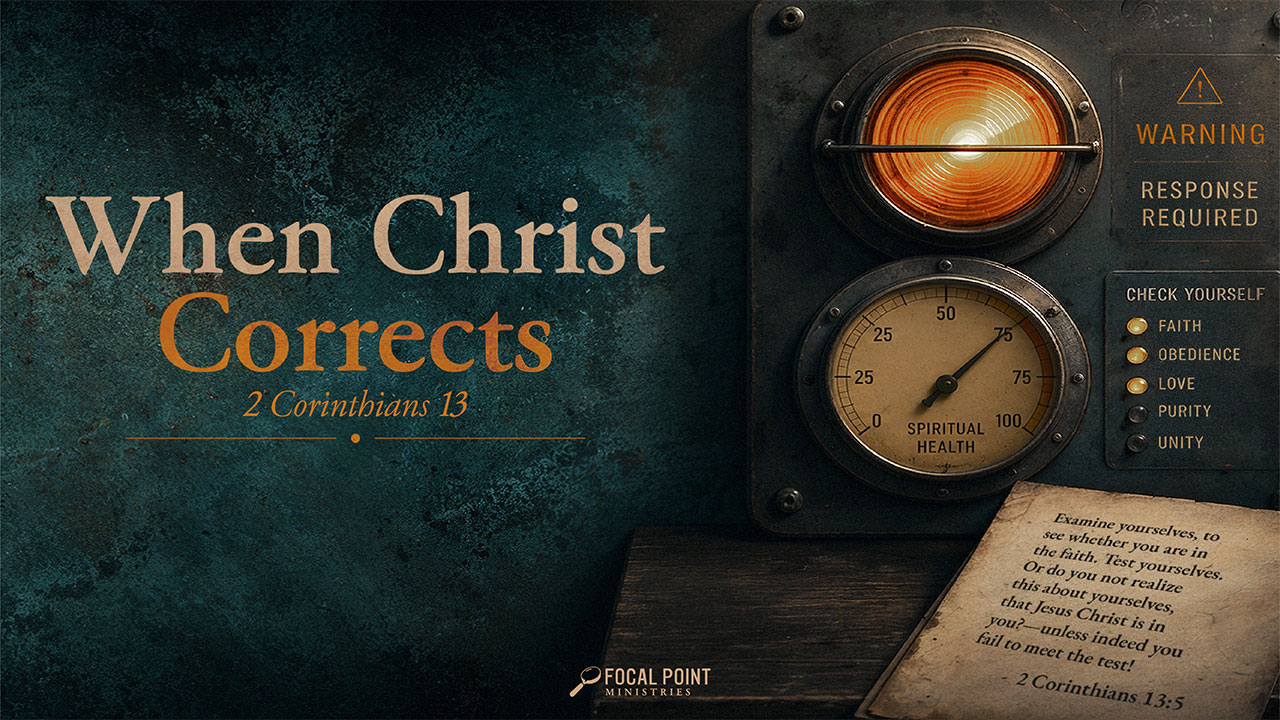
We don’t like tests. I get it. And you may not like tests. And we certainly don’t like pop tests, right? Pop quizzes. We don’t care for those. And sadly, if you didn’t read ahead in Second Corinthians Chapter 13, you’re going to have one. Because in Second Corinthians Chapter 13 verses 5 and 6, I would be engaged in clergy malpractice if I did not do exactly what’s going on in this passage. And as the Apostle Paul is turning the tables on the Corinthians saying hey, you’ve been trying to put me on trial about whether or not I am an apostle, whether or not, as it’s put in verse 3 of that passage, the authority of Christ is in me. He says, now I’m going to flip the tables on you and you need to examine yourselves. You need to test yourselves to see if you’re of the faith. You need to see if Christ is in you. This is a turning of the tables and he uses those words “to examine” and “to test.” So this is what needs to happen. And you need to do what Paul is asking this church to do. I’ve already done it because I had to prepare this test and take it while I was preparing the sermon. So we all need to do what this passage says. It’s a biblical thing for us to do.
So let’s roll up our sleeves and do what this passage is asking us to do. What the Corinthians were doing with the Apostle Paul is, are you really an apostle? Now Paul is saying to them are you really Christians? And it’s not out of spite that he’s doing this. Matter of fact, it’s part of a very insightful strategy because in fact they are Christians. It goes back to what we quoted last week in First Thessalonians 2:13. If in fact they are Christians and they are a product of him bringing the apostolic message and the power of God was at work in them receiving this message, well, then, you know, it’s vindication of his ministry that he is an apostle if they were changed by his message. So this is brilliant in part on the Apostle Paul. But of course, this is God’s Word trying to be codified for all time for us to get to this section in Second Corinthians as we read it or study it and say we should all do exactly what’s here. This isn’t the only New Testament text that does this. There are plenty, but we need to stop this morning and ask ourselves what they were having to ask themselves, is our profession of faith genuine? You say you’re a Christian and most of us here, I would think, most of us say we’re Christians. Are we, in fact, Christians? Is our profession real? And I guess the real question for us as we tackle this very short text, how would we know? Because the text itself sets up the question. But in the text we don’t have the details of the exam.
So we’re going to have to go to the broader context of Second Corinthians, and we’re going to have to think through what the test is, what does it consist of. And we can catch that in the context of Second Corinthians and the other Pauline epistles and we’ll see it throughout the Bible. But let us start by reading the text itself. So take your Bibles if you’re not already there, or your devices, and if you don’t know where to go, you can go to esv.org and you can just look up this text, Second Corinthians Chapter 13 verses 5 and 6. I’ll read it from the English Standard Version, the ESV, and we’ll try and examine this text here together and utilize it the way I think the Holy Spirit would have us utilize it, and that is to apply it to ourselves.
Second Corinthians Chapter 13 verse 5. Put your eyeballs on the text. Here’s what it says. It says, “Examine yourselves.” Now, that’s not literally what it says. If you’re reading the Greek text and some of you are, if you’ve taken Greek, you bring your Greek New Testament or your digital Greek New Testament, what it says sounds a little bit more like Yoda. It says “yourselves examine.” And in Greek you might know if you’ve taken some Greek. You don’t have to take much Greek to learn that sometimes the inversion of things like that, it’s not because it’s trying to be Yoda, of course, that would be an anachronism. But when you see things turned around like that oftentimes the sequence of words is putting things up front to put emphasis on it. But both this “examine yourselves” is really “yourselves examined,” because the emphasis is on yourselves “to see whether you’re in the faith.” And then the next one is the same thing “yourselves test.” Right? Because he’s been saying you’ve been putting me on trial. Yourselves you need to examine, yourselves you need to test. This is the emphasis here. “Examine yourselves,” put it that way for the sake of sounding normal, “to see whether you’re in the faith. Test yourselves. Or do you not realize this about yourselves, that Jesus Christ is in you?”
Now. That’s not the way we would normally think about the Triune God, because Jesus made it very clear fulfilling the Old Testament promise regarding the New Covenant, that it was about the Spirit of God indwelling people. That’d be the technical way to put it, as Second Corinthians Chapter 1 says, the Spirit of God is going to indwell us. But the reason it’s put this way in the immediate context is in verse 3 he says, “you seek proof that Christ is speaking in me.” And that terminology there is because is the authority of Christ in the things that you’re saying. So it’s a nice grammatical, rhetorical parallel to say, okay, you want to know if Christ’s authority is in me. I want to know if Christ is in you. Which, of course, if the Spirit of God dwells in you. Right? It’s shorthand. You could say, of course. Well, then the fullness of Christ, of course, dwells in you. And I’ll show you another reason why I think he uses that phrase when we get to it in a few minutes. “Unless indeed you fail to meet the test!” bottom of verse 5. And he says, “I hope you will find out that we have not failed the test.” Matter of fact, as I said, even contingent on the fact that if you pass the test you’ll see that we haven’t failed the test.
This is a very helpful passage, but let’s see if we can begin at the beginning in verse 5 and start with that first one. “Examine yourselves” or yourselves examine “to see whether you are in…” Now, I made a little emphasis when I read this on the definite article “in the faith.” Now, I’m not going to make the case just by the fact that the definite article is there, “the faith.” But it does start us down the pathway here of thinking through the fact that there is a definite article here. Usually you see the word “faith,” and you’re thinking about the fact that someone is going to put their faith in Christ, or even it’s used this way in Scripture grammatically, put your faith in the message of the gospel. You put your faith or your trust in something. Faith is a word that’s often abstracted in our minds in a religious context. But you need to think about the fact that we’re saying we’re trusting in… there’s a preposition behind it. Trust in. Okay, well, here it’s “in the faith,” right? We want to know if you are in the faith. The faith. Okay.
Let’s think that through for a second just based on how Paul contextually, we’ll get there in a second, and grammatically elsewhere talks about this. Three passages just to jot down quickly if you’re taking notes, and I wish that you would. Philippians Chapter 1 verse 27. I’ll give you the way he uses it with a definite article and some surrounding phrases that help us. He says this in Philippians Chapter 1 verse 27, “I may hear of you that you’re standing firm in one spirit, with one mind striving side by side for the faith,” here it comes, “of the gospel.” The faith of the gospel. Now, the phrase there “of the gospel” helps us to find what he has in mind here with the use of the words, the faith. The faith, this body of information that is defining what the gospel is, the faith of the gospel. Now, certainly in that passage that’s what he’s talking about, the faith of the gospel. We know what we’re dealing with here. Okay.
Here’s another one. Colossians Chapter 2 verse 6. This is going to be a composite argument here as I’ll make it. So this is just one piece at a time. Colossians Chapter 2 verses 6 and 7. It talks about the fact, really it’s verse 7, when it says you are “established in the faith,” right? I’m hoping that you’re rooted and built up in Christ, “established in the faith, just as you were taught.” Okay. You’re established in this faith. It’s like Paul says to the Ephesians, you’re not driven and tossed by the wind, but you’re established and rooted and grounded in it. You’re rooted and grounded in it, “just as you were taught.” You were taught the faith. I want you to adhere to the faith. I want you to stand-in the faith. I want you to be rooted in the faith. I want you to be, there’s that word, “established.” I want you to be grounded in it, that you know what it is. You were taught it. Now stick with it, this information, this body of information.
Thirdly, Titus Chapter 1 verses 13 and 14. This is the passage where he’s talking about those Cretan poets, because he talks about the Cretans and the way they talk about themselves. And he says, yeah, their “testimony is true. Therefore rebuke them sharply,” because those things they say about them negatively, well, those things are true, but you’re going to preach to them, Titus. He says, “that they may be sound in the faith.” And in verse 14, “not devoting themselves to Jewish myths.” Now we have a contrasting phrase. I want them to be sound in the faith. I want them to think about the truth of the gospel, about the faith, and be sound in it and think rightly about it. “Not,” in contrast, “devoting themselves to Jewish myths.” So the body of information that they’ve been taught, Titus, that you’ve taught them, that I’ve taught you, I want them to be sound in that, that they’re not drifting into things like myths. So we’re not talking here about the exercise of trust, the exercise of faith, we’re talking about a body of information, of doctrine.
Now, let me tie a bow on this by going back to the context of Second Corinthians, go back to Second Corinthians Chapter 11. This one I’d like you to turn to and look at, Second Corinthians Chapter 11. Now you might remember this passage if you’ve been with us in this study. He’s concerned about Satan utilizing these quote-unquote super-apostles to take them away from the truth. And he says in verse 4, the someone is clear in his mind about who the someone is, these false teachers. But “if someone comes and proclaims,” this is Second Corinthians Chapter 11 verse 4, proclaims, that means they’re teaching, they’re declaring, they’re standing up there and giving you a message. They’re proclaiming to you “another Jesus than the one we proclaimed, or if you receive a different spirit than the one you received,” which we defined this when we taught this section, which is about an experience that they expect you to have.
But the first one, “another Jesus,” how they describe who Jesus is, they have a different take on it. Or thirdly, “if you accept a different gospel from the one you accepted,” it seems that, “you put up with it readily enough.” In other words, you put the fence way down and there’s no barbed wire at the top. You have this message that we gave you. The two things in particular that don’t have to do with experience, but the Jesus that I taught you and the gospel that I taught you. And you’ve just let people come and just toss things over the fence and you have a different Jesus and a different gospel and it’s like, oh, yeah, you’ve kind of added that composite to it, and you tried to change your view of Jesus, and you’ve kind of adopted your view of the gospel, and it’s morphed into something else and you’re putting up with all that. You haven’t protected it. You’re not established in a sound view of who Jesus is, what the gospel is.
So when he says this, I want to make sure that you’re in the faith. “Examine yourself, test yourself to see if you’re of the faith.” I think I can make the case safely in the context here. And Paul’s other usage of when he starts to put a definite article in front of the word “faith” that we’re talking about the doctrine of the gospel. Like, what are you believing? Because he’s concerned in verse 3 that Satan might be using these people to draw them away into a different definition of Jesus or a different kind of gospel. And I don’t know. Let’s get out of the first century into the 21st century. Are there any religious movements, any churches, I don’t know, any YouTube channels and TikTok influencers pitching any different Jesus or any different gospel these days? I don’t know, anybody? Yeah, I think maybe. So the question is, are you going to be grounded and stick to the Jesus of the Bible and the gospel of Christianity and stay with that? Or are you going to have no protection on that and just kind of buy into a different gospel, a different Jesus, or are you going to be sound in the faith? You have to test yourself to see where you stand in relation to this body of doctrine.
Let’s put it this way. Number one, the first question you have to ask yourself is this. Number one, “Do I Trust in the Right Gospel?” Because there are plenty of different ways that people will talk about God, Christ, Christianity, salvation, the gospel, lots of different versions of that. What we want is the one “that were once for all delivered to the saints.” We want the one that was delivered to us through the apostles. We want the one that was given to us, Ephesians 2:20, that the church was supposed to be “built upon the foundation of the apostles and prophets.” Do we have that one? Because if you are being pulled away, you can think of this passage, Galatians Chapter 1, and someone’s presented to you another Jesus, and you bought that one or another gospel and you’ve bought that one, here’s what he says in Galatians Chapter 1 verse 8, “Even if an angel,” showed up after hanging out with God for a while and tells you that there’s a different gospel and you buy that one, let that one, that messenger of that new gospel, let him be, the old word is “anathema,” let him be damned. “Let him be accursed.” Let him be sentenced to hell. Because it doesn’t matter who brings you a different gospel. It doesn’t matter who says it. If it’s a different Jesus, a different gospel, then you’ve moved your way out of the truth and you can’t do that. So if you do that you’re not adhering to the truth. So we need the right gospel. Okay.
What is the right gospel? If you’re going to test yourself to see if you’re a Christian, if your profession of faith is real, if you’re really a Christian, which, by the way, we’re so good with our eyes pointing outward and our ears pointing outward at testing everyone else’s Christianity. I mean, how many people in this room listening to my voice right now have not said to some person in your church, in your small group, I don’t even know, I don’t even know if Jim’s a Christian. I don’t even know if Sue’s really a Christian. You’ve said that. But we don’t usually say that when we’re looking in the mirror at six in the morning. Right? I doubt you say that very often about yourself. We’re not good at that. Romans Chapter 2 says we’re not good at that. So let’s take some time to ask are you really saved? Right? Are you in the faith? Let’s start with that. The doctrine of biblical Christianity, the gospel. Well, what is it? First of all, let’s just recognize it doesn’t begin with the gospels.
The gospel doesn’t begin with the gospels? What are you talking about? No, the gospel doesn’t begin with the gospels. The biblical gospel does not begin with the gospel of Matthew, the gospel of Mark, the gospel of Luke, and the gospel of John. It does not. The good news of the gospel does not begin with Matthew 1:1. The good news of the gospel begins with Genesis 1:1. God did not give us a 27-volume, revelatory library. He gave us a 66-volume, revelatory library. That’s what he gave us. And it’s like you trying to go home tonight having a movie night and telling your family, hey, we’re going to have a movie night, and we’re going to watch a couple of movies, but we’re only going to watch the last 25% of the movie. We’re going to watch a couple of them, but only the last 25%. It would make no sense. That’s not a smart way to watch any movie. You need to not just say we’re hopping into the tail end of the Bible, because the tail end of the Bible, oh, it’s the crescendo of it for sure. We’re going to see “the Lamb of God who takes away the sin of the world!” But I can’t even say that sentence and have it really make the sense that it should make unless I know about the lambs in the book of Leviticus. I can’t even know about sin unless I understand something about Genesis Chapter 3. I can’t see the effect of what it means to take it away unless I see all the problems that it’s caused.
The reason I know this is the truth is because when I see good Jewish evangelists share the gospel with Jewish people, I see them often take it for granted that their audience understands the Old Testament. But when I see those evangelists, those Jewish evangelists, talk to non-Jews who do not know the 39 books of the Old Testament. Guess what? They do a crash course in the Old Testament. Turn with me to Acts Chapter 17. Let’s start in verse 22. Acts Chapter 17 is a great example of this when Paul is going to say, hey, do you want the gospel? We can’t start with Jesus. We’ve got to start with Genesis 1:1. We have to begin there. The New Testament is going to assume that you have an acceptance and affirmation and a trust in the truths of the Old Testament. Therefore, anyone who wants to decouple you from the Old Testament or detach the Old Testament or just say the Old Testament doesn’t matter anymore or God was really mad in the Old Testament, we just forget the Old Testament. You cannot.
The Old Testament is the foundation and the predicate for the New Testament. We cannot get rid of it. We have to go back to the Old Testament. And I understand in the Old Testament that many parts of it ceremonially have been fulfilled. Many parts of the governmental and civil laws. Right? They are certainly applicable to a national nation, the nation of Israel. But I understand we’re an international organization and the ceremonies have been fulfilled. But everything else that the Old Testament is going to teach us about God is God’s self-revelation that we need to say, oh, okay, what does it tell us? Well, it tells us everything about defining all the terms in the New Testament.
So Acts Chapter 17 verse 22, Paul is standing in front of a group called the Areopagus. The Areopagus are the people who met at a place called Mars Hill in Greece. And he says to this group of intellectuals, “Men of Athens, I perceive that in every way you are a very religious people.” And of course they were as Paul “passed along and observed the objects of your worship,” This is like the book of Ecclesiastes says, there’s some eternity set in people’s hearts. They are religious by nature. That’s how people are. “I found also an altar with this inscription: ‘To the unknown god.’” They had all these gods, a pantheon of gods. Of course, we know that from the Greco-Roman societies they had all these gods and they thought well, we don’t want to miss one so we’re going to have this altar set up, this temple set up to an unknown god. And here is Paul giving them a backhanded insult. “What therefore you worship as unknown, this I proclaim to you.” He’s about to talk about the one real God, which is going to slam all the other idols to the gods they think they know. And he’s going to say the one you think you don’t know, you’re right. You don’t know him. He’s the real God, and he trumps all the other gods and I’m going to tell you, you don’t know God. So let me tell you about the real God.
And he starts now in Matthew Chapter 1. No, he starts in Genesis Chapter 1 verse 24, “the God who made the world and everything in it.” If we don’t start there. If we don’t start with the fact that he’s made all things. If we don’t start with the fact that he is the creator, then we’ve missed the predicate of the New Testament gospel. Right? You can talk about it in the Areopagus. You can go to the universities; you can talk to the elites. But if you don’t talk about the fact that God made the world, then you’re never going to get the next thing here. “Being Lord of heaven and earth.” This is the problem. If we’re just a cosmic mistake, right? If this is all just time plus chance equals, you know, the beautiful person who you married, if that really is the reality, then we miss this, he’s the “Lord of heaven and earth.” The point of Genesis Chapter 1 is to remind us that we are not, as Psalm 100 says, that we’re not the makers of ourselves, that God is the King of all things because he’s the maker of all things. He “doesn’t live in temples made by man, nor is he served by human hands, as though he needed anything.” But notice this “he himself gives to all mankind,” present tense, “life and breath and everything.”
So he not only made everything in Genesis Chapter 1, but he sustains all things and therefore the relevance of Genesis Chapter 1 continues on. It continues on all the way to the first century, to the professorial types in Athens. “And he made from one man every nation of mankind to live on all the face of the earth, having determined allotted periods and the boundaries of their dwelling place.” He is sovereign. He’s in charge. He’s absolutely engaged with all the decisions, including down to when you were born, where you were born, and where your habitations would be. This is the God who is. And you can’t start in the beginning of Matthew and say let’s learn about Jesus, a great teacher who taught people how to love themselves, the Golden Rule. I hear this all the time from people trying to pontificate about Jesus and who he was. It starts with the fact that God is in charge of all things. This is why, by the way, it gets down to verse 30, “The times of ignorance God has overlooked, but now he commands all people everywhere to repent.” The reason people think Jesus came and offered some things and gave an invite to some things is because they don’t understand who God is.
Once you understand who God is you realize he’s not giving people invitations. He’s commanding all people everywhere to respond rightly to the message. That’s a completely different position of authority. And that’s why we can’t start with the New Testament. We have to start with the Old Testament. We have to start too when we think about repentance, why would we need to repent? Because there’s a problem that we can’t get two more chapters after Genesis Chapter 1 without running squarely into. And that is the fact that there’s a problem with sin, which we get into Chapter 2 with the problem of the fact that there will be consequences if you do sin. If you don’t recognize the authority of the God who made you there will be consequences. That’s Genesis Chapter 2. Now in Genesis Chapter 3 we see it play out. Adam and Eve want to be in charge. And they say we don’t care that you’re God and they choose to rebel. And by Genesis Chapter 3 we have the problem. And the problem is going to be so severe they can’t fix it themselves. We see them scurrying around in their shame trying to hide from God covering themselves with leaves. And we have the first example here of God saying I need to do something even to deal with your guilt, which isn’t solving the problem, but it’s putting a Band-Aid on it, pardon the pun, putting the Band-Aid on it to cover their shame.
Covering their shame, by the way, covering is the idea that picks itself up in the Mosaic Law and carries its way through the Old Testament, the idea of atonement, to cover. And here is the picture of God now killing an animal, skinning the animal and giving Adam and Eve clothes, something more permanent than a leaf, and saying I am going to do something here to start to show you how symbolically I’m going to fix the problem that you can’t fix yourself. You caused the problem. You rebelled against my authority. I’m going to fix it. See if you don’t understand the Old Testament and how this plays its way throughout the whole Old Testament, you’ve missed the fact that many people have studying the New Testament that Jesus comes, says a bunch of stuff about fixing our problem. And then maybe if I cooperate with him, I can now somehow take his teaching and build my way to the kingdom. Maybe I can do the things he says, learn from his great teachings, principalize my life, and make my way to heaven. I can climb the ladder to heaven. That’s not how this works.
Here’s a good example. Turn with me to Exodus 6:6, Exodus Chapter 6 verse 6. This picture I can tease this one picture through so many passages, but let’s just start in Exodus 6:6. It’s a great reflection of what happened in Genesis Chapter 3, and that is that here’s a problem they can’t fix. He introduces the idea of redemption. But notice how it’s pitched here in this passage. The solution, which is fully set on God’s own shoulders here, or more specifically on his arm. Exodus 6:6, God says to Moses, hey, “say therefore to the people of Israel,” I am Yahweh, “I’m the Lord.” This is the picture of God being the Eternal One who was, who is, who is to come, the I AM. I AM, here’s this name that’s supposed to show the authority of God. I’m the I AM. “I will bring you out from under the burdens of the Egyptians.” But why don’t you just rise up and overthrow them? I can’t. “I will deliver you from the slavery to them.” You’re enslaved to them. You can’t fix it. You can’t fix the problem yourself. “And I will,” here’s the word, “redeem you.”
How are you going to do that? I’m going to “redeem you with an outstretched arm and with great acts of judgment.” So I’m going to come and break the bondage that you’re in because you can’t do it yourself. You couldn’t even clothe yourself in your shame. But now I’m going to break the bondage that you have with my, look at this, “with my outstretched arm.” Now it all started with him hearing their groanings, I hear it, I’m going to come down because you see the problem. I’m going to with my own outstretched arm do something. I’m going to inject this series of miraculous events that was really, I mean, though we’ve had a few, was unheard of. Bam, bam, bam, bam, bam, ten plagues and I’m going to with an outstretched arm I’m going to redeem you out of that. This is a picture that lays down a pattern, that paradigm throughout the Old Testament of God stepping in to do something major, to show that this is all of God, all of God. God is going to do the whole thing.
Isaiah Chapter 59. Go there with me really quick. Isaiah Chapter 59. I know I make you memorize this passage in our Partners Manual, our discipleship manual. At least make you look at verse 2. I think I may make you memorize verse 1 also, but let’s pull this together. And I’ll leave you a homework assignment to go beyond this chapter. But in this chapter we see a couple references to this, the idea of the Lord’s arm. Isaiah Chapter 59 verse 1. Isaiah Chapter 59 verse 1, “Behold, the Lord’s hand.” There’s his proper name again, Yahweh, Yahweh’s hand, the infinite one, the one who was, who is, who is to come. His “hand is not shortened, that he cannot save.” You’re wondering why he’s not saving right now. Well, it’s not that he can’t “or his ear is dull, that he cannot hear.” You are not liking the consequences of sin. You think, okay, God, we’ve seen you do it in Egypt and in other places, but this is hundreds of years later. What’s the problem? Well, you’re not repenting. You’re not seeing your sin, “your iniquities have made a separation between you and your God, and your sins have hidden his face from you so that he does not hear.” He is not choosing to save because you are not recognizing the problem of your sin. But once they do, once they see the problem, you can scroll down here. All that’s going on in this passage, all the issues of transgressions, right? And they start to see that by verse 12 and verse 13.
Go down to verse 16. He wants them to recognize there’s no solution among them. There’s no man who can intercede. There’s no person who can do this. Look in the middle of verse 16, “then his own arm brought him salvation, and his righteousness upheld him.” So God has to step in with his own righteous right-hand, his own strong arm. I often say this from the pulpit, the picture of God reaching in to do his own redemptive work, this is the great picture. It’s even in the book of Romans, “the wrath of God is revealed from heaven against all ungodliness,” but this righteousness from heaven is revealed. These are the pictures from Isaiah. The redemption comes from God, the judgments are coming from God. Why? Because God is just. Man is sinful. God has to punish, but then he’s loving enough to step in at great cost to himself and redeem the people who deserve the judgment. This is the predicate of the New Testament gospel. If you don’t have it then you grow up like I did often thinking that Jesus is just an add-on to your life to bring you more love and more peace and more joy and more purpose. You just get Jesus and it’ll just be better for you.
You don’t feel the urgency of what I built into Chapter 9 of the Partners Manual, the urgency of the umbrella illustration that the real problem is you are enslaved and there is judgment coming. And you better get it right with God because you only have so much time. People hate this message. I mean, the world hates this message, but you get the whole weight of it in the Old Testament. And then you come along and say, hey, “the Lamb of God, who takes away the sin of the world!” Why is it such a problem? Most moderns don’t know why sin is a problem. You have to read the Old Testament to figure this out. We cannot decouple ourselves from the Old Testament. We can’t detach ourselves from the truth of the Old Testament. Stop with the genocide of Joshua. God is the giver of life. He takes it away. This is the truth of the Bible. He’s the potter, we are the clay. The reality of the greatness of God and the smallness of man that needs to be understood from the Old Testament so we can step into the New Testament and say God has provided a solution. “God so loved the world that he gave his only Son, that whoever believes in him would not perish but have eternal life.” It’s an amazing transaction you will never appreciate until you appreciate the bad news. You’ve heard me say that a million times. But you do understand, you cannot even understand the gospel of Jesus Christ until you understand the problem that I’ve just tried to spell out that’s all over the Old Testament.
They waited with great anticipation for all of that. And then it came. I preached about it. Was anybody here for Easter at Compass Bible Church? John Chapter 5, I preached verses 21, 22 and 23. A short little text, I may have preached more, but that was the heart of that text, the Christological text about who Jesus is. And here’s how it starts. It’s mind-boggling for someone who thinks that Jesus is a good teacher. Pick any cult group. Talk about cults, you know, oh, he’s the angel, Michael the Archangel, or he’s, you know, just a good teacher or prophet, whatever. Listen, if Jesus is not, as good theology will lead you to believe, fully God and fully man, what we call the hypostatic union, these two natures in one person, not co-mingled, not confused, here this one person. If we do not have that we do not have redemption. If it’s not God’s strong arm solving the human problem, then we’re lost.
And in John Chapter 5 verse 21, here he comes and says some mind-boggling things. Oh, the Father “gives them life, so also the Son gives life to whom I will.” Verse 22, right? The Father, do you think he’s the judge? No, I’m the judge. He “has given all judgment to the Son.” I’ll judge everyone. That’s mind-boggling to a first-century Jew. Unless, of course, you understand passages like Daniel Chapter 7. Unless you start to understand some of the Christological overtones of the Old Testament text in the books of Zechariah or Micah, you start to reckon, oh, maybe this is how this works. And then verse 23 of John Chapter 5, unless you “honor the Son,” “Timáō” “just as they honor the Father,” then you don’t honor the Father. You can’t honor the Father unless you honor the Son just like you honor the Father.
Tell me one Jewish person who takes seriously Exodus Chapter 20 and believes that you can’t honor anyone but God, tell me that Jesus is not God. That the “fullness of deity” does not dwell in bodily form right in front of you. That when Jesus says to Thomas, if you’ve seen me, you’ve seen the Father, right? The point of the deity of Christ cannot be diminished and every cult group will do that. They will denigrate the deity of Christ. And you need to understand, if you take any other Jesus than the Jesus who is presented to us in Scripture then you’re going to fail the test. You have to pass the doctrinal test. Do I trust in the right gospel? Why? Because you need someone who has all the gravitas, all the merits, all the righteousness to not only deal with your sin, but my sin and everyone else’s sin in this room who’s rightly responding to the gospel. If I said, hey, write me a $10 million check this morning. How many of us in this room could write a $10 million check? Well, if you can spell, all of us should be able to do that. All of us. And if you still have a checkbook somewhere buried in some kitchen drawer somewhere, you could go home and have one to me by tonight. Write me a $10 million check. Is my bank account going to get very big? Probably not, because there’s a big difference between writing a $10 million check and making sure I can cash your $10 million check. You better have enough funds for me to cash a $10 million check if you want me to be happy with my healthy heart. (audience laughing) There have to be funds available. Think about all the bounced check fees I’m going to have from all the bad checks that you write me.
Jesus on the cross said “Tetelestai,” right? “Paid in full.” He paid in full all the sins of all the people from every tongue, tribe and nation. All the people. The innumerable people whom the angels talked about as they talked to John in the book of Revelation, innumerable people, people beyond counting to the angels. That is what he paid for. Because the merit and worth of what Christ did was not human. It was more than human. But it had to be human. Why? Because he needed to fulfill all righteousness. Think about what you don’t have. I say this often, how did you do as a teenager and righteousness? Let’s just take righteousness and your teenager years. Let’s put your teenage years on the screen and let’s put righteousness on the other side of the screen. How did you measure up? I don’t know, pick one year, 16-year-old. How was your 16th year? Let’s just take six months of your 16th year. How did you do? Let’s just start with, I don’t know, your thought life. Whose life should we start with? I’ll put the brain-o-scope on somebody. We’ll put all your 16-year-old memories up on the screen. Okay.
What do we need? We need all 16-year-old righteousness to be thrown up on the other side of the screen that’s going to be credited to your account. Most people think that somehow later in your life, if you get right with God and you’re really pious. Maybe pray a lot of prayers. Maybe, you know, say the right prayers. Maybe march up cathedral steps on your knees. Maybe you can make up for all the bad stuff you did when you were 16. Does that work at a bowling alley? Right? I really bowled a great seventh frame. Can we just count that as the third frame also? Does that work? I don’t know, I haven’t done a lot of bowling but I don’t think that works. Right? You have to have a good third frame and a good seventh frame if I’m going to count both those frames as good frames, and you can’t have a great 35th year and count it for your 16th year because you needed a good 16th year. And Christ nailed it on his 16th year. Ask his brother Jude, he nailed it. And what you need to say is I need all of the righteousness of Jesus credited to me.
We learned this in Second Corinthians Chapter 5 verse 21. God “made him to be sin who knew no sin to be sin,” that’s the cross, “so that in him,” as I trust in him, “we might become the righteousness of God.” How can I be the righteousness of God? Well, I have to have my sins extracted, that’s true. But I need Christ and all of his righteous decisions, all of his righteous actions credited to me. He fulfilled all righteousness. That’s the transaction I need. Can you see that if you jump into the New Testament without understanding the perfection of Christ and the transaction of that perfection, fully God, fully man, we ruin everything. The message of the gospel. You can’t have another Jesus and you can’t have another gospel. And it’s all vindicated by this thing called the resurrection. Romans Chapter 1 verse 4, He “was declared to be the Son of God in power … by his resurrection from the dead.” If “the wages of sin is death,” both biological and relational, if you solve the relational problem that I’m one day going to see him face to face, well, then he’d better solve the death problem biologically. And of course he did. He’s “the firstborn from the dead.” Oh, yeah. There are a few people resuscitated who went on to die. He was the only one to come back from the dead and live on forever. That is the promise to all those who trust in Christ. And he did that to vindicate the whole process, to say that it worked. That’s the message. That’s the gospel.
The concepts, as I just tried to talk them through, anything short, you don’t have to be a theologian to be able to talk all the nuances of the atonement or whatever, imputed righteousness. But you better be able to say Christ is in charge, right? He made us. We didn’t make ourselves. We had a sin problem we couldn’t fix. God fixed the problem himself, right? He sent his Son, fullness of deity, dwelling in bodily form, fully God, fully man, and died in our place. Lived in our place. Rose again as proof of all that. And then he calls us to do what? Two imperatives: repentance and faith. Repenting, right? I know you’ve learned in some other church. You’ve learned in some book it’s “Metanoia.” It means to think after, change your mind. It does not mean that. It means way more than that. It means that as much as it means for a sheep to change his mind and follow the shepherd. Okay, but what does that really mean? It means the sheep is no longer wandering away. It means John Chapter 10 hears the shepherd’s voice and follows him. That’s what it means. Metanoia, right? I understand the compound parts of the word, but what it means is turning around. You’re no longer wandering like sheep. You’ve returned to the shepherd of your soul to quote First Peter Chapter 5. Metanoia does not mean to change your mind. It means what comes with all that.
“Anastrophe” is the other Greek word that is the synonym of that in the New Testament. It means to turn. I’m turning to Christ and I am trusting in Christ. You can’t have faith without repentance, and you can’t have repentance without faith. If you have repentance without faith, you have a 12-step program. And if you have faith without repentance, you have a Scantron test and demons take that and it does nothing. You need these two things turning in your heart which is going to result in a life change, from I am going my own way. I’m no longer, we learn this in Second Corinthians Chapter 5 verse 15, no longer living for myself, but for him who died for me and rose again. I’m turning from my waywardness to Christ to live for him. That’s repentance and I’m trusting in him. I’m trusting in his finished work for me, not in my own good works, but in what he has done for me.
Repentance and faith. These two things are distinctively defined but there are two sides of one response. You can’t miss that. They’re distinctively defined. You can define them and you can distinguish them, but you can’t separate them or you don’t have the response to the gospel. Repentance and faith. One word can stand in for the other. We see that in plenty of passages in Scripture but clearly assumed because one is a stand in for the other, because they both represent one response to the gospel. Penitent faith I often say, we turn and we trust. A lot of talk about that around here. I hope that’s not new to you. If it is, you need to go to our bookstore and pick any book on the gospel that we have in there. Or you can start with mine, Getting It Right. Just the two chapters I have on repentance and faith will at least go into more detail than you need, but I hope will fill in the blanks on what it means to turn and to trust.
Second Corinthians Chapter 13 verse 5 for the lack of time. “Examine yourselves, to see whether you’re in the faith. Test yourself.” Great. “Or do you not realize this about yourselves, that Christ Jesus is in you?” All right. That phrase as I said is not technically the way we would normally put this because we know that the third person of the Godhead is the one whom we usually talk about in Scripture as being in us. Even though it’s not said, occasionally it is said, but when it is said I think it’s for reasons that make sense, like Galatians Chapter 4 verse 19. In Galatians Chapter 4:19, Paul says I’m “in the anguish of childbirth until Christ is formed in you!” That’s not a moment in time. That certainly is a statement about sanctification. Christ is formed in you. And even in Colossians 1:27 the idea of “Christ in you, the hope of glory,” even that concept of hope in that passage, I mean, there’s something about the reality of me having the confidence and assurance as I see Christ in me. And in this passage as well. Do I see evidence, Paul, that Christ’s authority is in you? And he’s saying do I see the evidence that Christ’s character is in you? And I think that might be a fair way to put it. If I had more time I could maybe prove that proposition a little bit more strongly, but I’m fully convinced of that.
Let me put it this way. Number two, ask yourself, “Do I See Christ’s Character in Me?” Clearly, that is a biblical test, right? Do I see fruit? You’ll know them by their fruit. Jesus said that, it’s clearly a biblical truth. It’s worth writing down. Ask yourself the question, do I see Christ’s character in me, right? Do I see that in my life Christ is in me? What do I mean by that? Do I see Christ’s character emerging in my life? Now, when I say that do not hear that Pastor Mike is saying just the opposite of what he just said. And that is that if I see enough Christ likeness in my life well, then I qualify to go to heaven. It is not what I’m saying. That’s not what any biblical evangelist is rightly saying. That is not biblical theology. Biblical theology is you going to be the thief on the cross, put your trust in Christ, repent of your sins. You could only have two minutes to bear fruit. You might bear some in a sentence that you say but you could have no lifetime of fruit bearing and still be a genuine Christian. But were you to crawl off of that cross you would bear fruit. Would it be perfect? No, it wouldn’t be perfect. But the character of Christ would begin to emerge from your life.
You would, as Paul says earlier to the Corinthians, you would see the reflection of Christ growing from one level of reflection to the next. You would see this. Why? Because this is how it works. Matthew Chapter 28, the Great Commission, Jesus said, “Go make disciples of all the nations” How do you do that? You preach the gospel with this doctrinal body of truth. You tell them to repent and put their trust in Christ, and then you get them baptized. You declare this publicly. You assume them through this rite into the body of Christians, and then you start the process that will be for the rest of their Christian life, “teaching them to observe all that I have commanded you,” Matthew Chapter 28 verse 20. Now I commanded you a bunch of things, you eleven apostles, I commanded you these things and if you did those things you’d be a whole lot more like me. Now I want you to command them for the rest of their lives as disciples to do the things I taught you. And as you do they’ll be more and more like me. My spirit will indwell their lives and they will be more and more like me as you teach them to observe all that I commanded you.
Or how about this one? Jot this one down for sure. Acts Chapter 26 verse 20, Paul said I was telling people to “repent and turn to God, performing deeds in keeping with their repentance.” It’s exactly what John the Baptist said too, you repent and then you do things that are in “keeping with repentance.” You do what repentance would require. If you’re no longer straying like a sheep doing your own thing but following the shepherd, do what the shepherd says and you will do deeds in keeping with following the shepherd. What does the shepherd tell you to do? Do what the shepherd says. There are so many good examples in the Scripture about this, right? The thief stops stealing. You’ll work with your hands. Do what you should, be generous and share. Fruit bearing is in keeping with repentance, so much so that you should be able to look at the fruit in your life and say the fruit shows that I’m a Christian. And by the way, if you grew up in church, I see this all the time, but if you grew up in church, you say well, I’ve always been a good kid. You haven’t. Your heart has always been alienated from God, hostile toward God’s truth. You always on the inside have been about getting along, pleasing your parents, being a goody-two-shoes. You’ve been about pride and selfishness. All that has been who you are from the beginning. At some point if you really became a real Christian, then you’ve been rewired from the inside and your core desires have been changed to please God.
Then you’ve battled against your own flesh in a new way. Then it was no longer when my flesh wants something I’ll try to do it if I can get away with it. Now it’s I hate the fact that I desire the wrong things. As God put it through Peter, these passions of your flesh wage war against your soul. So I’m not asking you now that you’re a Christian do you stop sinning? I’m saying how do you respond to sin? What’s your relationship with sin? Is sin your enemy or your friend? I know that you’re going to sin as a Christian. The character of Christ is going to be imperfectly reflected. As we often say it’s not about perfection, it’s about direction. But you’re aiming for perfection. You’re aiming at Christ-likeness. You want to do what Christ wants you to do, and that is an innate desire that God gives you. It’s the kind of thing we talk about all the time. Scriptures are always going to say this kind of thing. We’ll pick up even on a little bit more of that in our passages in weeks to come.
Back to our text, “unless indeed you fail to meet the test!” That would be catastrophic. “I hope that you’ll find that we have not failed the test.” And that really speaks back to the fact that if we don’t fail the test then you haven’t failed the test. At least that, I think, is a synergy between these two concepts. Because if they say no, no, no, we’re real Christians, that is because he is the father of their faith. He came through town with the power of God’s Word apostolically and led them to Christ. So this is a good thing. But that test needs to be taken. Either pass it or fail it but get to it and figure out where you stand with Christ. So I just put it this way, just to make sure we bring this to a sharp focal point in your life. Number three, ask yourself, “Does My Profession Pass the Test?” I want you to be able to answer that. That is what God would have us all be able to do. I mean, you profess Christ if in fact you do. And if you profess Christ does it pass the test or not? I mean, I don’t know if you can do that while I’m yakking away up here on the platform but at some point you need to be able to do that. God, I want to look at what I believe. I want to look at my character. I want to look to see if I see Christ in me and emerging in my character. And I want to see if I’m believing the biblical things. If I’m trusting the right gospel and if I’m seeing fruit, well, then I think I do pass the test. Or no, I think I’m a poser and I’m not passing the test.
But here’s the deal, you shouldn’t procrastinate. It’s easy to procrastinate on a test that doesn’t have a date next to it. Compass Bible Institute classes just started this last week, and every exam on every syllabus has a date next to it. Every student knows when the tests are. The problem with this test is it just sits there on the page of Scripture without a date on it, and people struggle because they can procrastinate it. They can think, oh yeah, I’ll get to that. I need a quiet time down the road when I have more time, I can really give this some prayerful thought. Don’t procrastinate. Because really, as we learned in Chapter 6 of Second Corinthians, he says, “now is the favorable time; behold, now is the day of salvation.” So I guess you can see the test this way, right? The test is today. The test is now. That’s certainly how the book of Hebrews puts it. “Today, if you hear his voice, don’t harden your hearts.” Today’s the day. Today you have to figure this out. Don’t wait. Don’t procrastinate.
And by the way, I know we’re terrible witnesses against ourselves. If there’s a problem there and you’re not bearing fruit or you’re believing the wrong gospel, I know we’re not good at calling ourselves out. As I said we’re really good at calling other people out. That’s why Psalm 139, I quote it all the time, verses 23 and 24. It’s a good pattern of King David who is praying, “Search me, O God, and know my heart! Try me and know my thoughts! And see if there’s any grievous way in me.” That’s the punchline of it all. I mean, we want to call in God. God is a great witness against us, right? We need to be able to say, God, if my faith is in the wrong gospel, if my deeds are not right, if my core desires are wrong, call me out. I want to be able to get this right.
Jot this one down. Just two more passages to jot down. First John Chapter 5 verse 13. I just want to remind you that this is not a passage that you have to deal with every single day of your Christian life. This kind of call to test yourself and examine yourself is not something that God wants to keep you in a constant state of uneasiness and insecurity. First John Chapter 5 verse 13, another section of God’s revelatory library, he’s trying to tell us, “I write these things to you … that you might know that you have eternal life.” He would like you to be assured. This is a passage that’s supposed to help you get to a place of assurance. Of course, it has a rhetorical purpose in its context, but the purpose of all the passages, and certainly in the book of Hebrews, there are so many of them, is to give you assurance, even as it says in probably the hardest hitting passage in Hebrews, Hebrews Chapter 6 verse 9, he says I’m saying these things and speaking in this way, but I’m expecting and hoping for better things of you, things that accompany salvation. God wants you to be sure where you stand. And so we don’t want you to live in a constant state of uncertainty. God wants you to have assurance but you have to do this. You have to take the test. It’s not bad to periodically take it in one season of life, and then in another season of life. But you don’t have to take this all the time but you have to take it.
The other one is, I know it’s hard because sometimes if we’re not Christians our hearts are so deceptive. But Romans Chapter 8 verse 16 is the second passage I’d like you to write down. If we’re real Christians you can be assured because it says “the Spirit himself bears witness with our spirit that we are children of God. “If God’s Spirit dwells within you to be technically accurate, well then, of course, he wants you to be assured. The text wants you to be assured, the Spirit of God wants you to be assured. And you can leave assured. That would be good. That’s what God would have us do.
I don’t want you to utilize this sermon just to be able to nark someone else. You can have some dude in mind who you’re frustrated with, but please do what I think God would have us do with this text, and that is to use it as a mirror to consider ourselves before you ever think of anyone else. Put your name at the top of the exam. Make sure you ask do I have the right doctrine in my gospel? Do I see organic, Christ-like fruit emerging from my life? Make sure for the third point you can say something like I’ve been honest and I’ve made sure that my repentance and faith are real. That’s all really what this sermon is trying to do today.
Let’s pray. God help us to have that kind of honesty as hard as that is. And I know for non-Christians that is just so hard. I can ask so many non-Christians where they stand with you and even though they don’t like to talk about you, they certainly like to talk about the fact that if there is an afterlife that’s split with a good place and a bad place, they’re surely spouting their confidence about going to the good place. So I know, as Jeremiah Chapter 17 says that the heart can be so deceptive. I pray you cut through that by your Spirit this morning to all those who are hearing my voice right now and give us clarity that even if we have that shuddering feeling of fear that we’re not right with you, that we think, oh, what a horrible thing. As Matthew Chapter 7 says, to say, oh, we thought we were in and to hear from you, “I never knew you; depart from me,” that we can fix that and get rid of that fear by just repenting, trusting in your Son’s finished work. So lead us to that confidence even now for some who hear my voice right now, just let them have the grace of the forgiveness and the gift of repentance and faith even as they listen to what I’m saying. Work among us even this morning.
In Jesus’ name. Amen.
Additional Resources
Here are some books that may assist you in a deeper study of the truths presented in this sermon. While Pastor Mike cannot endorse every concept presented in each book, he does believe these resources will be helpful in profitably thinking through this sermon’s topic.
As an Amazon Associate, Focal Point Ministries earns a small commission from qualifying purchases made through the links below. Your purchases help support the ongoing ministry of Focal Point.
- Chantry, Walter J. Today’s Gospel: Authentic or Synthetic? Banner of Truth, 1970.
- Geisler, Norman L., and Ron Rhodes. Correcting the Cults. Baker Books, 2005.
- Grudem, Wayne. “Free Grace” Theology: Five Ways It Diminishes the Gospel. Crossway, 2016.
- MacArthur, John. The Gospel According to Jesus: What Is Authentic Faith? Zondervan, 2008.
- McDowell, Josh, and Don Stewart. Handbook of Today’s Religions. Thomas Nelson, 1996.
- Metzger, Will. Tell the Truth: The Whole Gospel to the Whole Person by Whole People. IVP, 1981.
- Rhodes, Ron. Handbook on Cults & New Religions: What Do They Believe? Harvest House Publishers, 2005.
- Roberts, Richard Owen. Repentance: The First Word of the Gospel. Crossway Books, 2002.
- Sire, James W. Scripture Twisting: Twenty Ways the Cults Misread the Bible. InterVarsity Press, 1980.
- Sproul, R. C. Faith Alone: The Evangelical Doctrine of Justification. Baker Books, 1995.
- Venning, Ralph. The Sinfulness of Sin. Banner of Truth, 1997.
- Watson, Thomas. The Doctrine of Repentance. Banner of Truth, 1987.
- Whitney, Donald S. How Can I Be Sure I’m a Christian? What the Bible Says About Assurance. NavPress, 1994.