
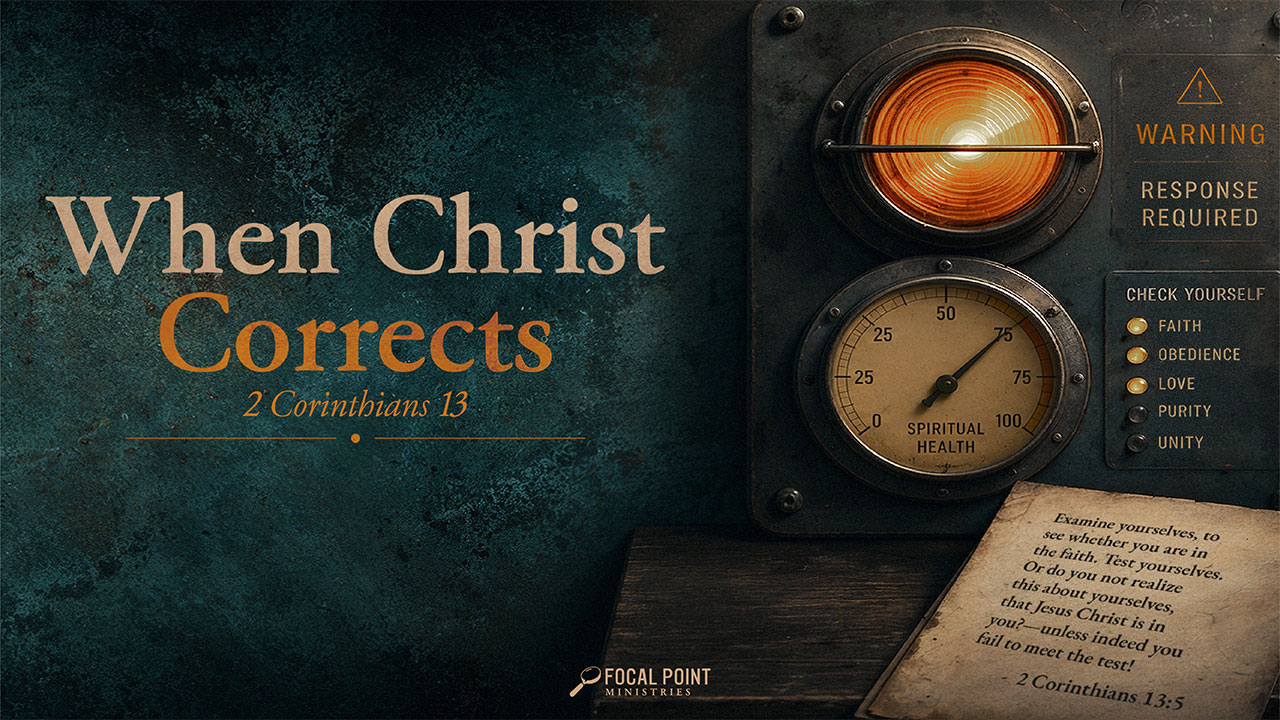
We must always take God’s warnings seriously and respond quickly so that the severity of his discipline is not compounded.
Downloads
Sermon Transcript
Well, imagine for a minute two hikers being handed identical topographical maps, you know, paper maps with all those squiggly lines on them. And the first hiker takes the map and he unfolds it, and he does what most people do when they have a map, looks at it, thinks for a minute, interprets it, and he’s ready to go. He’s making interpretations about what everything means, just intuitively, as a lot of people do, and he sees a section where all the straight lines are tightly compacted and they’re all together. And he thinks, okay, that looks like a nice even area and sees another section that’s bright green. He says, well, that must be a nice idyllic meadow and sees another section over here that’s completely blank. And he thinks, well, that’s great. That’s an unimpeded area. It’s a lot of smooth sailing there in terms of my hiking adventure. And then he sees two points that he wants to visit. And it’s really exciting because they’re only an inch apart on the map. So he thinks that’s great. I can visit both of those. And so he folds up the map, puts it in his pocket and off he goes to disaster.
The other hiker, he’s handed the map, he unfolds it and he does what most people don’t do. He goes to the little corner of the map where the legend is, the key to the map, and he starts reading that with all the small print. He spends time figuring out what everything means and what all the lines mean and what they indicate. And he starts to figure out that all those lines when they come together and they get real straight, well, that means that this is a cliff. And he starts counting how many lines there are. And he says, well, that cliff there that the other hiker thought was nice level ground was actually a 200-foot drop-off. And the part that’s green there, that bright green, that’s not a meadow, that’s a dense forest. This is timberland there. So that’s a place to get lost in. And then the part over here that has nothing on it. Well that’s not a nice easy place to hike. That’s uncharted territory that’s never even been mapped before. So no telling what’s in that area. And he also figures out the legend of the map where it says one inch equals twelve miles. So he’s very careful about what he chooses to visit and how close things are. So he takes the map, puts it in his pocket and sets out intelligently.
Intelligently. Not that the first hiker is dumb. It’s not that he’s dumb, it’s just that he’s not prepared because he didn’t go to the corner of the map and figure out what the map maker meant by everything that’s on the map. You have to interpret things based on the one who has designed it. And unfortunately, in the Christian life we often do what the hiker number one does and that is we look at our lives and think in the Christian life we can do what we did with the non-Christian life, and that is we can intuitively figure out our lives on our own, or at least we can listen to the world that tells us how we should interpret our lives. And we go about our lives without consulting God’s Word as carefully as we should. And in fact, that gets us in a lot of trouble, because intuitive thinking, as I often say, or feeling our way through the Christian life, is never going to work. We’re supposed to think our way through the Christian life and not our own thoughts, as it says in Proverbs Chapter 3, to “not lean,” or depend, “on your own understanding,” but in all your ways acknowledge him,” in all of our ways. And that means we’re going to think what God has to say about every pathway that we take. What is it that it means that I’ve run into this particular thing? What does it mean when this particular thing happens? What happens when I’m absent these particular things at this particular time in my Christian life? I have to interpret those things not just by guessing at it, not by how I feel about it, but by what God’s Word has to say about it. And I know that’s more work, and that’s not how people like to go about their Christian life. But we must go about our Christian life that way or we’re going to make some very wrong decisions. How tragic it would be for you and me to find out today that we’re misreading our present Christian life, and we dare not do that.
We’re getting into the very last chapter, as you’ve heard, in the study of Second Corinthians. We’re going to take five weeks, Lord willing, that’s the plan, to get through the 13th Chapter of Second Corinthians. And everything’s changing here in verse 1 of Chapter 13 as the Apostle Paul is going to change his tone. And as you’ll see here, just above the first verse of Chapter 13, the translators, at least, of the ESV, the English Standard Version, they put the heading above it that these are Paul’s warnings. So we’ve gone from a lot of defensive language from the Apostle Paul now to warning the Corinthians. And the tone is very, very different. And he’s saying some things that, in essence, are going to give us an interpretation of what’s going on in the lives of the Corinthians. And if we can get ourselves in the sandals of those Corinthians, I think that we can start to understand some things about our lives that we ought to understand so we don’t get into the same mess that they’re in. We’re just going to start an introductory lesson here today in the first two verses. But in the first reading you may say I don’t understand how this all fits. You will. It’ll all surface and emerge. But let’s read the first two verses of Second Corinthians Chapter 13 and see if we can’t find some answers that’ll help us not misinterpret our Christian life.
I’ll read this from the English Standard Version, here it comes, Second Corinthians Chapter 13 verses 1 and 2. Paul says, “This is the third time I’m coming to you.” That’s his plan. He’s going to come to Corinth. He says, “Every charge must be established by the evidence of two or three witnesses.” Now, if you have a Bible that should say very clearly at some point, some footnote there that this is a quotation from Deuteronomy Chapter 19 verse 15. This is an Old Testament text and it seems weird and out of place that he puts it this way. It almost seems like a stretch even to quote this text in this particular context. This is, you might remember, the very last book of Moses as he’s about to hand off the baton to Joshua who is going to take these people into the Promised Land. They’ve been wandering for 40 years this nomadic group of people who have been, you know, under God’s discipline. They’ve come out of Egypt where they had a nation, the strongest, most populous, you know, powerful, wealthy nation, Egypt, that they were under the leadership of. And now they were going to be their own nation, a nation among nations and they needed a civil law code. And so they were going to get a civil law code. And a lot of the details of that were given by God through Moses in the book of Deuteronomy. We saw it in Exodus as well, but we see a lot of it in the book of Deuteronomy.
And a lot of what we get in the book of Deuteronomy are things like this: Levi, you know, steals the farmer’s daughter, you don’t put him on trial just because, you know, Dan over there says, well, that’s what happened, right? You have to have two or three witnesses before you bring some kind of punishment. You can’t be punitive about something without the jurisprudence of something that we know for sure has happened. There ought to be confidence in this. Now, Paul is saying this is the third time I’m coming to you. In other words, I’ve witnessed how bad things are in Corinth. I’ve witnessed your disobedience. And so he now is saying that kind of like the law code says in the Old Testament that you don’t punish someone, you don’t bring any kind of justice to them unless you have two or three witnesses. Paul is saying, I’ve witnessed myself what’s going on there three times. I see the connection. But it’s kind of a weird, you know, employment of this text. And I’ll show you why in a minute. I’m not saying it’s wrong. It’s certainly right. It’s absolutely right. But at first blush it’s strange to see it there. We’ll look at it in a minute.
And here’s what he’s saying. “I warned those who sinned before.” Now we can even go to First Corinthians and say, okay, we do know that there were a lot of sins that were pointed out in First Corinthians. The most notorious, I assume, was the fact that there was incest going on with some people who sat there in the pews, if you will, of the church of Corinth, and no one seemed to care about it. Matter of fact, they seem magnanimous about it, if you know that word. They seem like, well, we’re a pretty gracious, kind, accepting, loving, merciful congregation. I mean, look how open-minded we are. And so that’s why he says next, “I warned those who sinned before and all the others.” Right? He warned them, why are you putting up with this? You know this is wrong. And there were a lot of other things he was warning them about. He says, “and I warn them now while absent.” Even this letter itself and the first letter that we have, the extant letter, the existing letters, I’ve warned you in letters. I’ve warned you when I was there. And he says, “as I did when present on my second visit.” Now I know this is all out of order, out of sequence. But you can see, he warned them in letters, he warned them when he came the second time, he warned them the first time. He is going to come the third time. And he says, you know, and “that if I come this third time,” he says, “I will not spare them.”
So all of this talk, even the heading that the translators put at the top of this in the English Standard Version, which of course is not God’s Word, it’s just the editor’s heading so we can kind of get a sense of the subject of this section, is filled with negative words. Negative words that don’t seem to fit very well with the sensibilities of 21st-century Christianity. Warnings. Or look at the words in the text itself, every “charge,” think about that. Here’s a Christian charging other Christians with things. Verse 2, warnings. Again “warn” in the middle of verse 2. And then this last phrase, “I will not spare them.” Like what are you implying, Paul? What are you going to do to them? What kind of punishment are you going to bring to them? I mean, these are serious words and they don’t seem to fit, at least the context of what most people understand Christianity to be. Christianity is loving and kind, and we’re supposed to be merciful and forgiving and gracious and as long as I use the word “magnanimous” and how open we should be and loving and accepting. Well, of course it does fit. It must fit. It somehow does fit because it’s sitting right here in the Word of God in the New Testament.
So we know this is part of the Christian life, and it shouldn’t be hard for us to understand how it fits. Matter of fact, let’s give it some words that might help us say, well, of course it fits. Even though if you were to use these words on Facebook to some middle-aged Christian woman with, you know, kitty cats and butterflies on her Facebook page who claims to be a Christian with putting up verses from the Psalms. She might push back at you if you use words like “sparing” and “charging” and “sinning” and all the rest. You do know that words like this are certainly applicable in the 21st century. People do wrong things. Christians do wrong things. There’s a word for that in the Bible. It’s called sin. Do you think Christians in the first century sinned? Yes, obviously. Do you think Christians in the 21st century still sinned? Do you think that’s true? Do you think we’ve gotten better at not sinning? No, matter of fact, read the Bible. We are worse at it now. Matter of fact, as time goes on, I think I can build this case from at least the pastoral epistles, things are getting worse. I can get that from the general epistles as well. I can get that from Pauline epistles. Yes, things are getting worse. So there’s a lot of sin throughout church history. It’s been there. It’s ubiquitous. It’s always there. Christian sin. “We all stumble in many ways,” James Chapter 3 verse 2. This is reality. If we say we haven’t sinned we’re lying, First John Chapter 1.
So there is sin. Christians do the wrong thing. Should they ever be, here’s a word, “corrected,” interactive church. Do you think they should ever be corrected? I think they should. I think they should. And this passage is about an apostle. An apostle, you might remember, is someone who carries the authority of Christ. And the authority of Christ, Christ is the king of the Church, he’s the head of the Church, he’s the Lord of the Church. And he wants the Church to do good. He wants the Church to do right. He wants the Church when the Church sins, to stop sinning, to stop doing wrong, and to start doing right. Any particular person, any particular family, any particular small group, any particular ministry, if they’re doing the wrong thing, he wants to correct them and have them do the right thing. Now that sounds altogether appropriate, does it not? Okay, I think that’s applicable for all time in the entire epic of the Church, right? We should always be saying when people do wrong, they ought to be corrected and do right. And certainly we want Christ to correct his people.
You noticed it was plastered all over your bulletin when you came through the door. I mean, we were telegraphing the whole point of this series in the last five installments of our study of Second Corinthians. That’s what this is all about. Christ’s correction. And Christ is going to bring correction to Christians. And unless you’re perfect and you can stand up now if you are. (Long pause) Okay, nobody? You’ll need correction between now and the time we have your funeral service. You will need correction. Christ will need to correct you because you will continue to do things you shouldn’t do, right? Sometimes it will be known. Sometimes your wife will know. Sometimes your small group leaders will know. Sometimes no one will know but you, but you will still need Christ to correct you. You’ll need to be corrected. So we need this chapter. You need this chapter. What I don’t want you to do is to think when certain things are going on in your Christian life, maybe like nothing bad is happening right now. You interpret that as there must not be anything that needs to be corrected in my Christian life. That’s not true as we’ll see. Or maybe that if there are bad things happening in your life, you think maybe God has stepped away for a while because when he was close everything was good. Feeling really tight with him as a new Christian, everything was great. Now things are bad. He must be on a vacation in my sanctification or something’s wrong here. Right? Well, something is wrong, but it’s not because he’s stepped away. Maybe he’s stepped close and in loving correction he’s trying to do something to change something in your life. There are a lot of things we misinterpret in the Christian life when all Christ is trying to do is correct something that’s going on in your life.
So this is the theme and we’re going to start with Second Corinthians Chapter 13 verse 1 here to take our first principle and to write it down, the first point of our outline today. It just is very important, it’s a very hard one to write. Your hand may quiver and shake while you write it down. I prepare you, I mean, you may have to write it with both hands. Okay. Are you ready? Let’s first read the first verse again. What’s happening here in the first verse? Let’s start with the first line, “This is the third time I’m coming to you.” He’s coming a third time and you know the context. The context is he’s warning, correcting, he’s trying to fix things. You’ve read First Corinthians. Now we’ve been through all of Second Corinthians except the last chapter, right? We know that he sent emissaries to them. He sent Titus there. We know there’s a lot of correction going on. We’ve read about the first visit in the book of Acts. There’s a lot of correction. And so we know there’s this constant involvement that God has concern for the church and Christ has, through the apostle, to correct. So this is a continual thing. God seems to be into it. And somehow we’re supposed to see this as a good thing, a thing that fits with a compassionate, merciful, loving, kind Christ. How does this work?
Well, to kind of distill this point, before we write this down with both hands, I want you to turn to Proverbs Chapter 12 verse 1 just to get the principle, because I know what most people think. This is a sobering series, and it’s not going to be fun. I wish we’d go back to the giving series, that would be more comfortable, you know, this is hard. Okay. I don’t want it to feel that way because Proverbs Chapter 12 verse 1 says it shouldn’t feel that way. And I know this is a stretch but here it comes. Here’s what the Scripture says, and it’s all about what we’re talking about here. Old Testament proverb that distills the whole thing. Here it is. Proverbs 12:1, “Whoever loves discipline,” this is what we’re talking about. Just like how we use the word when you’re raising kids, right? Johnny needs to be disciplined while he’s doing wrong he needs to do right. Right? If you love discipline when it’s happening to you, you love knowledge. “Whoever loves discipline loves knowledge, but he who hates reproof,” right? That’s the same kind of thing. Reproof means we’re turning you around. You’re going down the wrong path, but someone’s directing you to the right path. Whoever hates reproof, I don’t want to be corrected. Well, what’s that person? What’s the last word in verse 1, interactive church? What is it? “Stupid.” I just want to hear the whole congregation say the word “stupid.” (audience laughing) Stupid. If you hate correction you’re stupid. That’s stupid.
Okay. Now I’d like to say no one likes to be corrected but in saying that I’d be saying everyone is stupid. And I’d like to say here’s hope for us as Christians. I’d like us to grow in our maturity. At least I’m holding out the aspiration. Point number one. Let’s put it this way. I’d like us to “Learn To Love God’s Correction.” I’d like us to get to the first part of Proverbs Chapter 12 verse 1, “Whoever loves discipline loves knowledge.” I’d like to know how to hike through this Christian life and to do it right. I don’t want to fall off a cliff. I don’t want to be lost in a jungle somewhere. I don’t want to run into obstacles and impale myself on some rock. I would like to get through this and be guided with knowledge and discernment and wisdom. I would like to love that. Well, I need to be corrected. I need to be guided. I’d like to love correction. I’d like to love discipline. I’d like to love reproof. That’s going to take some maturity, I get that. Because all those words, they seem to equate in my mind to pain and there’s truth to that. All correction, it’s not pleasant, it’s painful. But there’s something about that pain that I should learn to love because I know what correction is.
Now that brings us to Deuteronomy 19:15 courtroom language quotation from Paul. Now let’s think about this. Levi steals the farmer’s daughter, goes to court. Why do I need two or three witnesses before we throw him in jail? Or, you know, have him stoned or whatever we’re going to do to the man, you know, kidnapper, the woman-napper in that case? Why? Why do we need two or three witnesses? Why not just, you know, Dan who says I think he did it. Why do we need witnesses before we judge him? Because we want to make sure we are right. We want to be right about this. We don’t want to be wrong and have the jurisprudence of our community or our nation in this case, as an Old Testament Israelite, we don’t want to be wrong about it. We want to be right about it. We don’t want to throw the wrong guy in prison. Okay.
Here’s the great thing about enlisting that quotation. Paul is saying, hey, I’m going to come and I’m not going to spare you. Well, it’d be really a big bummer if he’s going to come in and harsh out their wonderful day in Corinth if he’s wrong. It’d be a real tragedy if he comes in and he makes it really hard for the Corinthians and does whatever he’s going to do, because he doesn’t explain what it means to not spare them, and does some negative appearance in Corinth if in fact his critics were right and he’s wrong. But he knows he’s not wrong. The correction he’s going to bring as an apostle of Christ is the right correction. And this quotation reminds us of that because it gets back to the courtroom language of the Old Testament, where if you had two or three witnesses it was because you were doing the right thing, it was righteous judgment. And the great thing about God’s correction, that’s why the adjectival use of God’s name there, God, it’s always God’s correction that I need to learn to love, right? God’s correction means it’s righteous correction. It’s the right correction. It’s never the wrong correction. If God is going to correct you, it’s the right correction.
Now, with that in mind that’s one of the reasons I need to learn to love it, because if God’s going to correct me, that’s great. And let me show you how I can know it’s God’s correction. Second Timothy Chapter 3. Go there with me, Second Timothy Chapter 3. Paul is writing to Ephesus, the pastor there is Timothy, and here’s what he says. Of course, this is the stuff that Timothy already knows as the protege, the disciple of the Apostle Paul. But for our good now, for 2,000 years, here is this great text of Scripture telling us something very important about God’s Word. Second Timothy Chapter 3 dropped down to the bottom of the chapter. Look at verse 16. Put your eyeballs on this text. It’s so important. Second Timothy 3:16, “All Scripture,” right? The writings. That’s what the word means, the writings, all the writings. And of course, that’s a particular kind of writings. That’s why the English translators put a capital “S” on that word. All the writings of Scripture are “breathed out,” they’re breathed out, “by God.”
I love that the English Standard Version translators put it that way instead of using the word “inspire,” because inspire today means I had a stroke of genius, right? That’s not what it means. Or I’m motivated. Right? The Scriptures are breathed out. It comes from the Latin word “Inspiro” and inspiro is the word in Latin to “breathe out,” to blow out. Right? And that’s unfortunate that word in Latin from Jerome’s Vulgate made it into Tyndale’s translation in English and into the King James Bible and most English translations today. But the New International Version and the English Standard Version, thankfully, have put in this now phrase “breathe-out,” because breathe is where we have the word inspiro, which turned into the word “inspiration.” If you look up inspiration in the English dictionary today, though, what does it say? It’s saying what we’re saying when we’re inspired to clean the garage or inspired to wash the car. That’s not what the word means, and it’s certainly not what we’re saying about the prophet or the apostle. He’s not inspired. That’s not the point. The Scripture is “Inspiro.” What does that mean? The Scripture is breathed out. The writings are breathed out. What does that mean? Well, it’s really clear in the book of First Peter that the prophets were guided along by the Spirit, carried along by the Spirit of God, the third person of the Godhead. And what was written down, the product, the writings themselves were as though God was saying it. God was breathing it out.
God doesn’t have breath, right? God doesn’t have vocal cords. God doesn’t have teeth. God doesn’t have a tongue. Right? He doesn’t need all of that. But the breath, interesting and ironic, the word “breath,” both in Hebrew and in Greek, is the word “spirit.” He breathes out, the Spirit, the third person of the Godhead, is guiding the apostles and prophets in their writing to give this product, the writings and the writings, the products of the writings of the apostles and prophets is as though God himself has breathed out those words. And those words that we have are what? Well, they’re “profitable.” For what? “For teaching.” Like what we’re doing right now. For, here’s a word, “reproof.” What does that mean? Changing the direction of people who hear it. Or let’s just use the word we’re used to and “for correction.” So the Bible is there to correct people. It wouldn’t need to correct you if you were perfect. Anybody perfect? Did anybody stand up if you’re perfect? I forgot. Do we do that in the service? No, no. Nobody is perfect. So the Bible is here to correct you. “A lamp to my feet and a light to my path.” Make sure that when you’re stepping in the wrong direction the Bible is to correct you, to reprove you, to rebuke you, to exhort you, to say you’re going the wrong direction.
So God’s correction is biblical correction. If I can’t biblically prove correction. Or if your friend comes to you and says you’re wearing the wrong shoes. Oh, okay. Right? If you can’t show scriptural support for why you’re wearing the wrong shoes well then it’s not God’s correction. It’s Jim’s correction. And I don’t know, Jim’s correction depends on how much I appreciate Jim. Maybe I’ll take Jim’s correction. But really what I know is righteous correction that I want to love every single time is God’s correction. And I know it’s God’s correction if I can see it in Scripture. And Scripture is full of things that should correct us all the time. Which, by the way, implies this very simple thing which is the fifth question, I think, on the discussion questions this week for your small groups, what is your relationship to God’s Word? I mean, are you in it all the time? Do you spend time in it? Are you a Psalm 1 kind of Christian where you are spending time meditating on this book day and night? Do you have it in your mind all the time? Do you read it? Do you meditate on it? Do you memorize it? Do you study it? This book needs to be a part of what you think all the time and it will correct you.
And you ought to sit under the preaching. Look at three verses later, Chapter 4 verse 2. Paul says to the preacher, Timothy, “preach the word,” whether they’re applauding for you or not, “in season or out of season.” Now here are some corrective words. “Reprove, rebuke, and exhort.” Now exhort is more of a shore up people. Rebuke is to tell them when they’re wrong. Reprove, the first word, is an interesting word, again, it’s the idea of moving them off a path into the right path “with complete patience and teaching.” Why? Why is it going to be so hard? Because “the time is coming when people will not endure sound teaching,” verse 3, “but having itching ears they will accumulate for themselves teachers to suit their own passions and will turn away from listening to the truth.” Well, I’m glad that hasn’t happened yet. Someone in the back responded. That was sarcasm. I think it has, hasn’t it? Plenty of people today don’t want to hear things that, oh, let’s look at the words “reprove, rebuke and exhort” them. They don’t like God’s correction. They don’t want to be reproved. They don’t want to be corrected. They don’t love God’s correction. And unless you’re perfect, every time you open God’s Word there’s something that’s going to be corrected in your life. It’s a mirror, James Chapter 1. And you looked in the mirror this morning and unless you woke up perfect you made some corrections, I hope. Did you?
The mirror, God’s Word is the mirror. And you understand what that’s saying? It’s going to show you stuff about yourself, and you’re not supposed to look at it and walk away and forget what you saw. You have to do something about it. “Be doers of the word, and not hearers only.” And you’ll be blessed in your doing, not in your hearing. Hearing alone is not it. God’s correction is always righteous. Do you know why it’s also a good thing that you should learn to love? You should love the correction because the correction is always out of love. You know that, right? Always out of love. Jot this one down. Revelation Chapter 3 verse 19, which is just one of many examples in Scripture. Here’s what Jesus says to this church, the church of Laodicea. And as you know it’s not a great church, at least not at this particular time. He says, “those whom I love, I reprove and discipline.” Two words all about correction. I correct people whom I love, right? Like a mom who has some kid come in from playing outside with a nasty, dirty, deep splinter in her kid’s finger. I think about that, buried in the finger. He comes in crying, Mom, look at this splinter in my finger. It hurts. It’s terrible. Waa, Waa, Waa, Waa, Waa. What does mom do? Right? Mom looks at that and says, yeah, that’s a really bad splinter. But if I try to get that out, it’s going to hurt. So just forget about it. Go back to playing outside.
Now no mom who loves her kid is going to do that. Matter of fact, most moms have this built into their genetics. They start thinking all these terrible things. They think infection. They think, you know, I don’t know, I can’t even think of all the things that they think. They think… They go there all the way to the E.R., amputation, you know, ICU. So they’re running to get, you know, the Neosporin and the tweezers, and they’re going to get that thing out. And they’re willing to put their kid through some pain to take this foreign object out of their baby’s finger. They’re going to do that because they love their kid. And that’s the problem. Hebrews Chapter 3, “the deceitfulness of sin.” God does not want you to continue in the deceitfulness of sin. So he wants to correct you and he will correct you. He may even send an Apostle Paul into your life over and over and over again, because he wants to correct you. God’s correction is always out of love, like a mother who wants to make sure a kid doesn’t end up in the hospital with bacteria or tetanus or whatever moms are thinking.
And one more. Hebrews Chapter 12, which is also in your discussion questions this week on the website and on your worksheets. It says in Hebrews Chapter 12, God says to us, we ought to see the discipline that God brings to correct our lives as an encouragement. Now, this is really hard to see as encouragement when it’s happening, because he even says in the passage. He says, none of this discipline is pleasant. It’s all unpleasant. It’s painful. So how am I supposed to be “Parakaleō”? How am I supposed to be encouraged when I’m going through the pain of correction? That’s why I don’t like correction. But I’m supposed to love correction if it’s God’s correction and you’re telling me because it’s out of love. Well, okay, I’m not feeling like I’m being loved because you’re beating me up, God, I don’t want to be beat up. Paul is saying I’m not going to spare you. That sounds bad. And then you’re telling me this in that text. I should be encouraged because God disciplines his sons. And if you’re not disciplined then you’re not his son. You’re an illegitimate child, right? I never spanked the next-door neighbor kids. I wanted to many times, (audience laughing) but I never did it. Never. I spanked my own kids many times. Right? The difference was because they’re my kids and God says the same thing. Even within the Church, you can see this. Some among you are weak, sick, and some have even died because of the sin around the Lord’s table. And he says, because of that I’m disciplining my people.
I’ve seen in this church, and I think any pastor of any length of time can say this about the congregation. We’ve seen people sin repeatedly after being warned and after being confronted, and some encounter discipline from God, which is clear and others do not. It’s an easy way for us to see those who are really God’s sons and those who are not. And I will say this even and I don’t come asking about this because I’m not going to say, but some have even died. And in that weird sense of them dying in an untimely death, I’ve had encouragement to think that I see that this is a child of God, and I’ve seen others continue in the same kinds of sins where God has taken a life and I’ve realized, no, they’re not God’s kid. God’s going to deal with his kids because they’re his kids, and that’s how much God is committed to his children. So when you’re being disciplined by God, I know it’s hard in the middle of it all, right? I mean, it’s hard for me to tell my kid in the middle of discipline when he was a little kid, hey, be encouraged by this, would you? Because I don’t spank the next-door neighbor’s kids. That’s when he’s going to want to move into the next-door neighbor’s house. But at the end there is maturity down the road that I hope he recognizes. Certainly when he sees the outcome of the next-door neighbor kid versus his own life. That’s all I’m saying. There should be some sense of encouragement that we have that God’s correction is for his own people.
Yeah, the coach who gives up on a player, right? Some soccer team or some little league team, he doesn’t holler at the player more who he gives up on. Right? He stops hollering at the kid. And that’s not how it is in the Christian life. It’s sons or not sons. But I’m just telling you, if you have that God bearing down on you through a text of Scripture, through a sermon, through a book you’re reading, some constant refrain of a scriptural text in your mind, whatever it is, circumstances. The Word of God keeps biting at you. Then I’m just telling you, these are things that God is doing because he loves you. The coach is bearing down on you because he hasn’t given up on you. He hasn’t stopped correcting. He hasn’t stopped training. He hasn’t stopped giving you his input. And Paul says, I’m keeping at it. And he is God’s emissary of correction in the lives of the Corinthians.
All right. Verse 2, “I warned those,” go back to our text, Second Corinthians 13:2. “I warned those who sin before and all the others,” who were watching, “and I warn them now while absent.” I mean, look at the letter I just wrote, “as I did when present on my second visit.” I warned in person, I warned in letter, I warned, I warned, I warned and I warned, I warned, I warned, I warned and I warned, and I think it’s like the woman at Costco with the kids in line saying, I warn you, don’t do it. Don’t do it. I’m going to count to three. I’m going to count up to five. I’m going to count to ten. I’m thinking, oh, I won’t even charge you. I won’t even count. I’ll take over. I mean, you’re just like stop. You’re all bark and you’re no bite, mom. Don’t you feel that way sometimes? Just stop. Your kid doesn’t believe you. Your kid doesn’t believe you. And I read this text, and I think, Paul, you’re starting to sound like the mom in the Costco line. Really? And then I know you’re going to end with, if I come again, I’m not going to spare you. If I have to get out of bed one more time to come into this room and you ask for water, here we go. Arghh! Really? You’ve been in twelve times already. Paul is starting to sound like that. And I’m thinking the kid might start thinking or the Corinthians might start thinking, really? Really? You sounded like a softie to me.
If you’re tempted ever to think that and you might because there’s something about God that will tempt you to think that, because there’s something so incredible about God. He’s very, here’s the word, old translation, long-suffering. He’s very patient. You might think that patience somehow spells he’s really not all that concerned about the sin that you’re embroiled in right now. Number two, “Know God’s Patience Is Not Indifference.” God’s patience is not indifference. And you may think I’ve learned to quell the warnings. I’ve learned to quell the passages of the sermons or the verses or whatever, the songs even on the Christian, you know, playlist I have. I know I feel the tinge of conviction, but I’ve learned to put all that in its place because I just think it’s not a big deal to God because God hasn’t done anything. I got the bark, I got the bark, I got the bark, but there’s no bite so God’s okay. God’s okay because nothing’s happened. That’s misreading the map you understand. Don’t misread the map. That is not what it means. Do you know who thinks that way? Pagans think that way. Pagans among us think that way.
Psalm 50, turn to this one would you please? Psalm 50. The casual attenders who came to the worship center in the Old Testament, thought like this. Start in verse 16. The casual attenders on the Temple Mount, Psalm 50, start in verse 16. “But to the wicked God says: ‘What right have you to recite my statutes or take my covenant on your lips?’” Now think about what that means. First of all, he’s calling them wicked. He’s putting them in a category of you are consistently by pattern in your life sinning against me. And then he’s saying, “you recite my statutes,” that’s the Bible and “you take my covenant,” the words of the covenant, “on your lips.” So they’re reciting Scripture. They’re probably doing that through the recitations, the sayings of Scripture. They’re saying things, they’re singing things, they’re singing Scripture. And so they’re in the congregation of worshipers but they’re wicked. They keep doing sinful things. A lot like how Paul saw the Corinthians. I mean, you assemble together but look at you guys. You’re a mess.
How do they do that? Well, there are people who are there. They’re being confronted. But verse 17, they hate correction, they “hate discipline,” they hate it. Well, what happens when they get confronted and warned? Oh, I’m glad you asked, look at the middle of verse 17, they “cast my words behind you.” God comes with a warning. God comes with you need to change. You need to stop. And they take those words and they dodge them right over the shoulder. They come and they just pass them right off. They cast God’s words behind them and they keep on with their sin. “If you see a thief, you’re pleased with him.” Thumbs up. “You keep company with adulterers,” you have no problem there, no sensitivity to that. “You give your mouth free rein for evil.” You don’t even feel the guilt. You just go for it. “Your tongue frames deceit.” You’re good at lying. “You sit and speak against your brother; you slander your own mother’s son. These things you’ve done, and I have been silent.” Why? Because God is indifferent about those things? No, look at what he says, he’s calling them wicked in verse 16 because of them, he’s itemizing them. He’s keeping track of all of them. He does not like it. They’re egregious to him.
But he was silent. Why? Because God is patient. God is patient. God is long-suffering. The New Testament word, by the way, is a compound word “Makrothymia,” you’ve heard me say this before. Makros. I just say that because you know that word. It’s made it into English. Makros means “big,” “long,” “large.” Makros. “Thymos,” we know that word, “thermós” and “thermometer.” Right? Heat. Right? Makros is a long way until you get hot. Long way until you explode. Long way until you burn, right? The point is, you’re “long-suffering.” You go a long way until you explode, a long way until you get angry. So with God it’s a long way until he does not spare you. A long way until he comes in judgment. A long way, and from our perspective, until he comes in discipline.
So there’s a long period of time. God is good at being patient toward his children before he does bring the discipline. He says, I was silent. And what did you think during that interval between the sin and my discipline? “You thought,” middle of verse 21, “you thought that I was one like yourself.” You seem to have no problem with all these sins. You thought I had no problem with all these sins. Talk about misreading the map. I didn’t do anything. I didn’t discipline you. Lightning didn’t strike you. Nothing was scaring you. Nothing was giving you foreboding feelings. When the words came, you were easily ducking them. You were putting them over your shoulder, casting them behind your back. You continued headlong into all the compromise you were involved in and I said nothing. And you thought God doesn’t have a problem with my life right now. But I do have a problem with your life. It’s time now for me to break through all that. “Now I rebuke you and lay the charge before you. Mark this, then, you who forget God,” at least the real God. You have some sense of God because verse 16 says you’re reciting his words, but you’re really not tuning into the totality of the Holy God. Mark it now, last chance, “lest I tear you apart, and there be none to deliver!”
God’s patience is not indifferent. And by the way, there are not just casual attenders who sit among us who think this way, or people like your next-door neighbor who will say they’re Christians. They don’t even go to church, right? Which says, don’t forsake the assembly of yourselves together, they’ll call themselves Christians. They say they’re going to heaven just like you. But, no, they say if God really wanted me to go to church I’m sure I’d be struck with a lightning bolt. I mean, that’s what they think. And you warn them they should go. They should be a part of what God is doing in this world. They cast the words behind them. It’s not just those people, the casual attenders or the people who claim to be Christians and do their own thing. The book of Jude, the little one-chapter book in the New Testament. Verse 4 says, there are teachers within the church, they’re false teachers, who teach that theology makes this a reality. They turn the grace of God into a license to sin, into a license to do what you want. So they’ll say, just like the Corinthians were saying, the reason we don’t do anything about the incestuous relationship that everyone knows is going on in our church is because grace, grace, grace, grace, love, grace. We have books in the bookstore about grace and love and forgiveness and so we’re not going to deal with that. God is love, and we can point you to churches in our town that will say that kind of stuff about all kinds of sin they know is going on in their church, but they don’t call it sin because God is love.
That kind of false teaching is all over the place. In other words, God’s not torching the people who claim to be Christians, but he doesn’t step in and discipline them because they’re illegitimate children. They say, well, that patience is indifference. But let’s talk about what non-Christians are encountering. They’re encountering Second Peter Chapter 3 verse 9, which says do not count God’s patience, slowness “as some count slowness,” because it’s not slowness, “but is patience toward you.” It’s a kind of patience that’s waiting for people to come to repentance, “not wishing that any should perish.” He wants people to come to repentance. The waiting is opportunity for repentance. Or better yet, Romans Chapter 2 verse 4, which I know that all of us have encountered, that sense of, oh, man, maybe this is a key for my Christian life right now. It says this, “do you presume upon the riches of his kindness and forbearance and patience?” Listen to those three words. “Do you presume on the riches of his kindness?” How kind has God been to you? Here I am in South Orange County talking to people who I know, if you sat there and tallied, count your blessings, name them one by one, the “kindness and forbearance and patience” of God. You could tally some of that. And then it says don’t you know “that God’s kindness is meant to lead you to repentance?” Some of you think his kindness, his forbearance and patience spell that you don’t need repentance. This passage says it’s to lead you to repentance. Again, don’t misread the map. Sometimes that period of time that everything is tranquil and peaceful is to get you to start praying Psalm 139. “Search me, O God, and know my heart! Try me and know my thoughts! And see if there be any grievous way in me.”
But you know how this ends. Verse 2 in our passage Second Corinthians Chapter 13, “If I come again I will not spare them.” And this really is the final boarding call. I mean, think about it. Speaking of boarding calls, you’ve been to the airport lately, right? Have you ever really thought about how many times they tell you to get on the plane? I know it’s a million times they tell you to get on the plane, but you can’t really get on the plane yet because you’re not the super gold, platinum plus, you know, gold, silver star, with 15 whatever million miles, you know, whatever. It’s that and then you have to be like a military, then you have to be a dog lover or whatever. Then you have to be whatever. All of this. And then finally we get around to boarding group number one and then number two and then number three then number four. A million times they’re telling you to get on. And then it’s like, okay, everybody else, and then all of you. And then finally, please, now final boarding call. Now final, final boarding call. Now we really mean that. You better get on the plane. Then Doctor Fabarez, are you around because you’re not here yet? Please get on the plane. Right?
They do all of that and you can start to think maybe, maybe, just maybe, they’re just so many calls to get on this plane that even if I am stuck over here, you know, getting a bottle of water at the newsstand or whatever, if they do happen to shut the door, I know how this works. They’ve called them a million times. I mean, talk about all bark and no bite. I can show up after they close the door, and I’m sure they’re going to open it because they told me 15 times to get on the plane. Plenty of chances. So I’ll walk up if it’s closed and say, hey, hey, ladies, just let me on, let me on. Does that work? Trust me. I’ve pondered it from the Dallas Airport Hotel after missing the final boarding call. It doesn’t work. You can’t get on once they close the door. It doesn’t work. It may be that you think that the final boarding call is not the final boarding call. When Paul says if I come again I will not spare them. I don’t have the historical data to try and talk you through what actually happened here. But I can tell you we better believe it when we sense this may be the last time God warns me on this sin. There may be some kind of discipline that’s going to be so costly. I do not want to presume upon the patience, forbearance, kindness of God. Time does run out. The doors do close. There is a kind of discipline that’ll matter. So where does that lead us?
Number three on your outline. You better “Take All God’s Warnings Seriously.” Every warning, the first warning ought to be I need to do something about it. I need to confess and repent. Every time you feel the warning you ought to put this word in front of it. Final warning. Final warning. I know that Paul kept saying, I warned you, and then I warned you, then I warned you, then I wrote you and warned you, and I warned you, and now I’m going to come and warn you. I get all that. Don’t presume upon how many times God’s going to warn you. Just don’t presume upon that. It’s like, you know, you go to the doctor four years ago and he says, hey, man, your blood pressure’s too high. Your cholesterol is through the roof. Triglycerides. I’ve never seen numbers like that, you know? And you do all that and then you say, oh, but I feel fine. Then three years ago. Hey, still too high. Way too high, Too high. Too high. Ah, I still feel fine. Two years ago. Too high, too high, too high. Ah, I feel great. Right? At some point we’re planning your funeral, right? At some point we’re planning your funeral. You can’t just put it off. You have to at some point say I better believe the warning. And you’re going to have to take all God’s warnings seriously. And the warnings, I mean, bodily stuff is of little importance. What’s important is your soul, your walk with God. And those warnings matter.
Turn with me to Proverbs Chapter 9. I don’t want us to end this without looking at this great text. Proverbs Chapter 9. It pulls so many things together when we’re thinking about God through the Apostle Paul saying if I come again, I’m not going to spare you. What does that mean? Some kind of discipline, some kind of apostolic authority to discipline them. It reminds me of the smoke alarms in our house that I guess they tell you you’re supposed to change those nine-volt batteries. I know your house is more modern than mine, and yours is tied to the electrical system, but mine still has those nine-volt batteries, which you’re supposed to change every New Year’s Day or something. But I don’t have time for that. So they always go off at two in the morning, random days. And there are two kinds of men who deal with this in two different ways. The first kind of man hears this at two in the morning. He sits up, reaches into his nightstand with a flashlight that’s, of course, fully charged. He has slippers probably neatly next to his bed, he probably has a robe, he probably has a ball cap he puts on. And he goes hunting through the whole house, checks on the kids, he checks every closet, he makes sure nothing is smoking anywhere and nothing’s on fire. He checks all the, you know, burners on the stove. He goes all through the house, comes back, reports to his wife. All is fine. Then he goes and, you know, finds a nine-volt battery down in the kitchen and changes it all out. And 30 minutes later he tries to go back to sleep.
Then there’s the rest of us, right? We don’t open our eyes. We shuffle down the hall, grab the closest chair, if he can find a broomstick or something we’ll take a whack at the smoke detector hoping that if we hit it just right, not only will it knock it off the ceiling, maybe it’ll knock the battery out of it at the same time. If it stops, we shuffle back to bed. We’re back to sleep in three minutes. We might burn to death in the house. And it’s not a prudent way to go. That’s not wise. Proverbs 9:7, I think is a good summation of the difference. “Whoever corrects a scoffer gets himself abuse, and he who reproves a wicked man incurs injury,” gets a broomstick to the side of his head. So “don’t reprove a scoffer,” if you know you have one, “or he’ll hate you.” He just doesn’t like the shrill sound, the irritating sound of your alarm, your warning, Paul’s warnings. No, I don’t want that. I don’t want a sermon that’s going to tell me I’m not doing everything right. I want to find a church that tells me that everything’s cool and copacetic and fine. And, of course, I’m doing everything right, and I’m awesome. I want that. I want to get into a Partners relationship in a discipleship where every guy tells me I’m the best partner he’s ever had, I know everything. I’m going to go to a small group where I’m never challenged. I want them to say I’m the best Christian they’ve ever met.
But you “reprove a wise man, and he’ll love you. Give instruction to a wise man, and he’ll be still wiser; teach a righteous man, and he will increase in learning.” Yeah, but that makes you feel like when you go to something and you hear something that stings, you read a book that convicts you, you listen to a sermon or a podcast that goes to the Word of God and pulls out the hard stuff and makes you think, it’s not comfortable. Yeah, the fear of the Lord is not comfortable. Verse 10, but “the fear of the Lord is the beginning of wisdom, and the knowledge of the Holy One is insight. For by me,” by the way, wisdom, “your days will be multiplied, and years will be added to your life.” Discipline, by the way, could subtract days and years from your life. “If you’re wise, you are wise for yourself.”
Here’s an interesting thing as it relates to your sanctification. “If you scoff, you alone will bear it.” You might burn up if you don’t heed the warnings. “If you scoff, you alone will bear it.” Don’t delay. You know what the Bible calls for. Proverbs 28:13, “Whoever conceals his transgression,” you ignore the warnings, “will not prosper, but he who confesses and forsakes them will obtain mercy.” That’s the promise, you will obtain mercy. “If we confess our sins,” First John 1:9, “he’s faithful and just to forgive us our sins and to cleanse us from all unrighteousness.” It couldn’t be better than that. God’s promise. He is faithful to that promise to obtain mercy. Isn’t it great that Nathan only had to confront David one time? I get it. David was bad. But there’s confession. There’s repentance. I’ll have to ask my dentist but I’ll bet he never hears a patient say, I’m glad I waited months to fix this tooth. Do you think he ever hears that? I tend to think by experience the longer you wait the worse it gets and the longer you’ll end up sitting in the chair getting it fixed. You do yourself a favor, right? If you scoff you yourself are going to bear it. If you don’t heed the warnings.
Don’t misread your Christian life. Things may be going great for you and you may think that means that you’re hitting the sanctification out of the park. But I think we all should read Psalm 139 and reflect it in our prayer life. We ought to be open to the sting of a hard-hitting Christian book, or a sermon that makes us uncomfortable, or a Christian friend who says things that make us shake our heads and wonder why he or she said that. If we let God correct the interpretation of our life I think we’re the kind of person who may let God actually correct our life. And that’s the wise man. One verse I’ll leave you with, Proverbs 1:23. The personification of wisdom says, “if you turn at my reproof,” if you would turn when I’m trying to reprove you, he says then, “behold I’ll pour my spirit to you.” Right? Small letter “s.” This is the personification where wisdom will be poured out on you. I’ll just give you more wisdom, and “I’ll make my words known to you.” Just like I read earlier. Right? The idea of you’ll be still wiser. There’s great promise for those who are willing to be corrected. Much more on this to come in Second Corinthians Chapter 13.
Let’s pray. God help us all to be correctable, to be asking you for a soft heart, a malleable heart, a heart that says, search me, try me, know me. We know the problem of living in this fallen world in a fallen flesh is an unavoidable transgression. But we can compound that with hard hearts. So we want to come to you, whether it’s just you calling Scripture to mind or having someone do that in one way or another, or circumstances doing that, to be able to say to you we want to be corrected, we’ll take your warnings and hopefully God be still wiser. Get us ready for what we’re going to learn in this great chapter and I pray we’d be off to a good start even this morning because of what we’ve studied just now.
In Jesus’ name. Amen.
Additional Resources
Here are some books that may assist you in a deeper study of the truths presented in this sermon. While Pastor Mike cannot endorse every concept presented in each book, he does believe these resources will be helpful in profitably thinking through this sermon’s topic.
As an Amazon Associate, Focal Point Ministries earns a small commission from qualifying purchases made through the links below. Your purchases help support the ongoing ministry of Focal Point.
- Adams, Jay E. A Consumer’s Guide to Preaching. Victor Books, 1991.
- Burroughs, Jeremiah. Gospel Fear: Developing a Tender Heart that Trembles at the Word of God. Soli Deo Gloria, 1997.
- DeYoung, Kevin. The Hole in Our Holiness. Crossway, 2012.
- Fabarez, Mike. Sanctification: Thinking Rightly About Our Christian Growth. Compass Press, 2017.
- Love, Christopher. The Mortified Christian. Soli Deo Gloria Publications, 1998.
- MacArthur, John. The Vanishing Conscience. Word Publishing, 1994.
- Ortlund, Raymond C., Jr. God’s Unfaithful Wife: A Biblical Theology of Spiritual Adultery. InterVarsity Press, 2001.
- Owen, John. Overcoming Sin & Temptation. Crossway Books, 2006.
- Pache, René. The Inspiration and Authority of Scripture. Moody Press, 1969.
- Packer, J. I. Rediscovering Holiness. Servant Publications, 1999.
- Ramey, Ken. Expository Listening: A Handbook for Hearing and Doing God’s Word. Kress Christian Publications, 2010.
- Ryle, J. C. Holiness: Its Nature, Hindrances, Difficulties and Roots. Charles Nolan Publishers, 2001.
- Thoennes, K. Erik. Godly Jealousy: A Theology of Intolerant Love. Christian Focus Publications, 2005.