
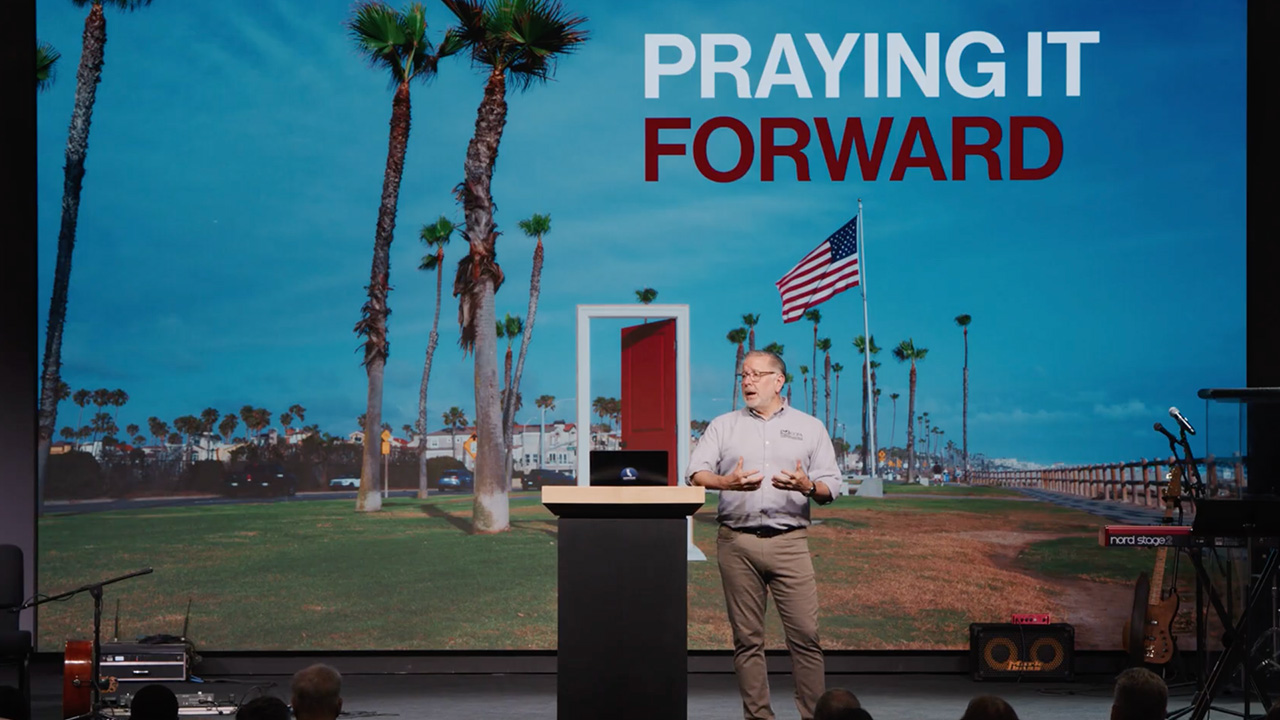
We must be more committed and intentional in our prayer lives, deliberately expanding our praying to include God’s evangelical agenda.
Downloads
Sermon Transcript
Well, you know, I have to say it from my own mouth. This church hosting the National Equipped Conference was amazing. You guys were fantastic. If you did volunteer my own bravo to you. It was so amazing. You guys were the most hospitable. We had the red carpet rolled out for us. If you’re part of the volunteer team just thank you so much from the bottom of my heart. And I am saying that with a little sweaty palm because we’re going to have to do it in 2028 because we’re bringing the National Equipped Conference to AV next time so you guys can come and invade our territory and we will host it for you next time, unless the Rapture takes place, and then we will just scrap the plans altogether. We’ll let the non-Christians deal with it. I think they’ll just cancel. How about that? So yeah, National Equipped Conference in 2028, if there is a 2028 for us, we’ll be up in AV, which stands for Aliso Viejo.
Hey, in the last service, you know Pastor Bobby is bringing up all these pastors. He brought up his brother in the last service, and he made a few jokes about how he did not look like his brother. And it’s hard to believe that that’s his brother. And that made me, as I was sitting here watching all that think about me and my brother, because my brother also is a pastor who is busy preaching this morning in another place. And I thought if I brought my brother up on the platform you would not believe that he’s my brother. I won’t say more than that because there are lots of thoughts in my mind that you don’t want to hear and I don’t want to have to apologize for. I don’t think I ever looked like my brother, or I never really wanted to claim him as my brother, but we grew up here, not far from here, at Bellflower Boulevard and Atherton, across kind of catty-corner from Cal State Long Beach. And, you know, typical little, tiny house, one bathroom. You know living in that little home being typical, you know, Long Beach kids. And he was into watching a lot of television and movies with war in it, which now as I’m saying it out loud makes a lot of sense as to why I got beaten up a lot as a child by my brother. But it was a lot of war, you know, whether it was, you know, Civil War movies or westerns where they’re shooting each other or World War II movies. It was all about war, war, war, war. He was watching that all the time. I, on the other hand, you know, I didn’t care to sit there and watch a lot of TV. I was out building ramps for my bike to jump over trash cans. Did anybody back in the day do that? And I would come in if Evel Knievel was going to jump over some buses or something, then I was going to come inside and certainly watch that. The Wide World of Sports, do any old timers remember that? What was that Saturday afternoon? I would watch that mostly just for the intro. Right? The agony of defeat. That’s when I would lean in. Nobody? Okay, young people, look it up. We have free Wi-Fi, check it out. It was what we did.
And occasionally we would play a few games together. And the kind of games we played when we were kids were the kinds without any rules. And the one that we did a lot was we had a little tiny trash can full of army men, those little green plastic army men, and we would dump those out on the backyard concrete. And we’d play like we were choosing teams for kickball, and we would separate them all one by one and choose our teams. Well, I’m always going to choose the one with the most formidable weapons. So I wanted the guy with the big bazooka over his shoulder. And, you know, I picked those that look like they were the most imposing. And I’d see him reach for the guy that had that backpack with the little antenna on his backpack, and I’d say something like you’re so stupid, right? That’s so dumb. Why would you want that guy? I doubt backpacking. I’m going to shoot him so fast and, you know, it’s dumb. And then, of course, when you call your older brother dumb he’s quick to say you’re so dumb and you’re so dumb because you don’t even know what this guy is. And I say, well, you’re right, I don’t, but I don’t need to because I’m going to shoot him anyway. And he says, well, this is the radio man. You don’t understand this is a radio man, this is our comm guy. If we don’t have a communications guy. Right? Your whole army is going to be hung out to dry. If you don’t have a guy who is communicating with the headquarters, if you don’t have somebody talking to the commander your army is not going to know what to do. Now, he’s taking it way too far in his imagination, because all we’re going to do is take rubber bands and paper clips that we break in half and shoot each other’s army. And whatever we did, we had some, you know, M-80s from Taiwan or whatever. We would blow each other up. But whatever we would do with our army men to blow each other up, it was just, you know, in his mind, he had to have the communications guy.
Now, today, if I ran into a situation like that and my wife can attest to this, I will always say things when we fall into situations and that kind of line comes out of someone’s mouth or out of my own mouth, I’d say that’d make for a great sermon illustration. I do say that a lot, at least twice a week, because when you talk about a little army man with an antenna and a backpack and he’s your communication man, and your army is hung out to dry if you’re not talking to the headquarters and the commander, I’m thinking that’s a great sermon illustration. Because at a prayer conference talking about prayer, nothing could apply better than that. And there are a lot of Christians thinking they have a great Christian life, and their prayer life stinks and they think they’re doing well and they’re not. They’re not doing well. Like the intro of the book that we handed out this week. And if you didn’t get one of those, you certainly should get one of those. I’m not trying to sell books, even if you can’t afford one. I mean, we’ll give you one if you can’t afford it. But this book on prayer that a lot of us contributed to, I wrote this page and a half intro, and I start talking in the very first paragraph about the fact that if someone tells you they have a great marriage but they never talk to each other, they don’t have a great marriage, right? Would you agree with that? And so you can say you have a good relationship with God, but if you’re not doing, as the psalmist says, pouring out your heart to God regularly, you don’t have a good relationship with God.
Do you remember what Christ says in John Chapter 15 that he is the vine, right? His Father is the vine dresser, and you are the branch. If you want to bear fruit, you’d better abide. It’s a weird little Greek word “abide” which means “to remain.” “Ménō” is a Greek word to hang on, to be tightly connected. How are we tightly connected to Christ? Well, there are lots of things involved in that, I assume, he doesn’t go on to explain it in the passage, but certainly we know you’re not going to have a tight relationship with anybody unless there’s a lot of talking. If you’re not talking a lot. Now, God has talked to us and he’s given us a pretty big book, right? 66 books in this library of conversation that he’s having, but he wants us to come and talk to him, and he says you have to pour out your heart to me. I want you to say things to me. He’s given us the Psalms. The biggest book in the Bible is a songbook, 150 songs. And a lot of those are really heartfelt communications to God where the psalmist is pouring out his heart to God and saying here’s what I’m feeling, here’s what I’m thinking. And this is very important that we do this. And if we don’t do this, we’re in really big trouble. We don’t have that connection to God. And we can say we’re out there doing the Lord’s work and fighting for the Lord, and we’re salt and light in the world, and we’re trying to be out there putting on the armor of God doing all this. But we are not really connected the way we should. And we think we’re bearing fruit and it’s plastic fruit. We’re not bearing fruit because we’re not abiding in the vine.
Now, I can say all that. And for a lot of people you can slump back in your chair if you’re a real Christian and say all that does is make me feel guilty. That makes me feel guilty. And I get that. I get that. I read books on prayer and it makes me feel guilty because I think I know I should pray. There’s no Christian in this room, probably no non-Christian in this room who walks in and says well, you know, I didn’t even know there was a prayer. I didn’t even know we should pray. I don’t know anything about this. Everyone knows about prayer. There’s nothing complicated about the concept. And everyone knows, if you’re a Christian, that you should pray and everyone’s heard people talk about prayer. And so it’s not about the knowing. It’s always about the doing when it comes to prayer and we can feel guilty that we don’t pray enough. This conference was not about trying to induce guilt. You know that and this sermon right now is not about inducing guilt. And I’m not going to open up a passage and try and dump a bunch of information out there and say, hey, here’s more information to make you feel guilty. It’s not really about information. The hope is transformation. We’d like to transform your habits. We’d like to transform your actions so that you are pouring your heart out to God more often. And even if we’re just taking some small steps in that direction we’d say that’s a victory because we like you to continue to build on that. We want you to talk to God more. That’s what we need to do. So don’t look at it like, oh, I got slammed, I felt guilty and all that. We want God’s Word that the Bible says, “is living and active, and sharper than any two-edged sword.” It should get down to start with a little conviction. I get that. We’re going to feel convicted. It’s going to start to deal with the thoughts and intentions of our hearts. But I want us to leave today saying I’ve heard some things and I’ve seen God’s Word reveal some things that kind of give me some rails to move forward on. I know where I should be going in my prayer life.
Now, if you were at the conference at the end of this weekend, you hopefully have heard a lot of things that have been helpful. But today I just want to kind of put it all on a rail and say here’s what we want going forward. And I want to have a kind of prayer life that we want to aim for and something that can be sustainable, some kind of things that we’re going to shoot for in our prayer life. So open up God’s Word. A very short passage of Scripture, just three verses. Colossians Chapter 4 verses 2, 3 and 4. And let’s see if we can’t pull out of this God’s words. Because of course, I know Paul’s writing this to a bunch of Christians, but it’s God’s Word. Every passage has two authors, right? It’s God and the prophet or the apostle, in this case the Apostle Paul, writing not to pastors. This is not a pastoral epistle. This is just a regular set of Christians in a city called Colossae and he’s writing to them and he’s telling the rank-and-file Christian, hey, you guys have to pray. And the way he tells them to pray is super helpful for you and me as we move out of this weekend thinking about our prayer lives. So let me read it for you with a little bit of commentary and then we’ll try to pull some things out of this that can really help to transform our prayer patterns.
Colossians Chapter 4. Put your eyeballs on this text and let me read it for you. “Continue steadfastly in prayer.” Now that phrase “continue steadfastly” translates one Greek word and steadfastly is probably not a word you used this morning before you went to church. It’s probably not a word you use this week, right? That sounds kind of antiquated. Steadfastly. This isn’t an old translation, the English Standard Version, that I’m reading from but still we want to try to update this a little bit in our minds. We’ll get to that in a minute, but we need to understand that word and the thrust of that word. But even reading it, I think you get the idea of something that needs to be a regular part of what we’re doing. Prayer needs to be a regular part of my life. It means more than that but let’s at least start with that in our head. And then it says, “being watchful in it.” And even that, that’s kind of churchy isn’t it, a churchy word? Watchful. Have you used that word? Maybe if you work on a boat or something. But I don’t know. Watchful. It’s not a word we use all the time. But you’ve heard it in church, right? Matthew Chapter 26. Jesus is there. He has Peter, James and John, they’re in the Garden of Gethsemane. He’s about to be betrayed by Judas. He’s going to go to the cross and he says, hey, Peter, James, John, I’m trying to have you pray with me but you keep falling asleep, right? And he uses this phrase, can’t you “watch and pray?” And it’s the same Greek word “watchful” here in Colossians Chapter 4 verse 2, as he uses over there in Matthew Chapter 26. And it’s very important that it relates to something about how I pray that I’m not dozing off. And then he says as you’re praying “with thanksgiving.” So this is all about prayer. Continue steadfastly in prayer, being watchful in prayer, and do your prayers with thanksgiving. So that’s the kind of praying we want to have.
And then he says hey, as long as I’m talking about you praying he says here’s what I want, “At the same time,” as you’re doing all that “pray also for us.” Okay? Now pray for us. And so Paul and the people who are with him, “that God may open to us a door for the word.” Now Paul loves this phrase. He uses it a lot in his writings. Now you know this isn’t a hard metaphor to understand. This is an opportunity. I want an opportunity for me to say the things that God has said in his Word in the Bible. Right now he’s dealing with the written word of the Old Testament, the 39 books of the Old Testament. “To declare the mystery of the ‘Christos,’” the Christ. That’s the Messiah, the “Mashiach “in Hebrew, or what we transliterate as the “Messiah.” So the Old Testament is filled with prophecies about the coming Messiah. Well, Christ came, Christ, that’s the Greek word christos, and the Messiah has arrived. And the Messiah was Jesus of Nazareth, born in Nazareth, and he fulfilled all the Old Testament prophecies. He’s calling him the “mystery.” Now, that’s a Greek word itself that we transliterate, “Mystērion” is the Greek word in the Greek text. Transliterates into the English word “mystery.” And it doesn’t mean like Sherlock Holmes needs to figure this out. A mystērion simply means in the Old Testament it wasn’t so clearly laid out that everyone could have looked in the Old Testament and seen a clear, you know, Technicolor, you know, high definition 4K picture of what it looked like. But clearly in the rearview mirror they saw what it was, and it was a mystērion. It wasn’t clearly laid out with every detail but there was no missing it once it came.
So I need to declare all the stuff in the 39 books of the Old Testament because the New Testament was being written as he was writing this “on account of which I’m in prison.” This is one of the prison epistles, right? Philippians, Ephesians, Colossians, Philemon. These books were all written from prison and the end of the book of Acts as he’s under house arrest and he’s writing these letters and he says here, I’m in prison because I keep talking about Christ of Nazareth, Jesus of Nazareth, being the Christ. And the Jews have gotten me in trouble with the Romans and now I’m in prison. But now that I’m in prison, I want to make clear this message about who Christ is, who Jesus is, “make it clear, which is how I ought to speak.” Anyone who is going to talk about Jesus ought to make it crystal clear who he is. Okay, all of that commentary but that’s the text. We need to make sense of this.
Let’s start in verse 2, very simply see three things. But this is all about the kind of prayer life we need to shoot for. So let’s put it this way. Number one, “Aim for This Kind of Prayer Life.” Let’s give it a title and now let’s give three categories to this starting with the first one. Now before I give you the first one let me start with the word itself, which isn’t going to be the way we write down the heading, but it will get to it. Okay? So here’s the word. It’s a compound word in the New Testament Greek language. And the only time I like to talk about Greek, not the only time, but the time I usually talk about a Greek word is when the Greek New Testament word is a compound word with a preposition. Because whenever there’s a preposition, which is a word you might remember that relates to some kind of spatial connection, right? Like “under” or “over” or “next to” or “beyond” or “inside” or “through.” Well, this is the word “toward” or in Greek “pros.” Toward. And then it’s the word “strength,” towards strength. That’s literally the word that’s here. And it translates in our text in terms of the grammar and how it’s put in the language, “continue steadfastly.” Now it’s a hard translation in my mind and I’m not sure if I were on the committee I would have voted for that translation but the word itself is your prayer life should be a kind of prayer life that’s towards strength. Okay. What does that mean? Okay. I like to put it this way. It’s a muscular prayer life. And if it’s a muscular prayer life, what kind of prayer life is that?
Okay. Let’s put it this way. If I’m there at work or with some of the cool dudes at church and all they talk about is their Iron Man thing they’re going through, or they’re going to do this marathon or whatever. That’s the kind of conversation I want to start making jokes about, because I want to distance myself from that as quickly as possible because I have no interest in doing any of this. And I want to kind of make clear if I can joke my way out of it, or just talk my way out of it, I want to make clear I have nothing to do with that. And ha, ha, ha, ha, you know, and just I’ll talk about donuts and Del Taco. You can talk about biking for hundreds of miles and swimming or whatever they do. I don’t understand any of it. But they’re going to talk about it because, you know, if I were to… they’re in the middle of their training and they have their watches that do all this stuff. And, you know, they’re putting their infusions in their body or whatever they’re doing. I don’t know what they’re doing, but they’re ready to do something that is muscular. Right? And if they say, pastor Mike, why don’t you do this with us? They’ve long since given up on saying that sentence. They used to say why don’t you train with us for this? Okay? The reason I don’t want to train with them for this is because if I were to try to train with them, they would realize after about, I don’t know, 700 or 800 yards of trying to train with them, I would want to stop for a meal or a snack at least. (audience laughing) I won’t have the ability to persevere, right? I don’t have the wherewithal to persevere. I can’t do… I’m not going to bike for hundreds of miles and run for whatever a marathon, or I don’t even know what an Iron Man is, but you have to be iron to do it and I made a flesh. I can’t do it. (audience laughing) You can become iron, you can do it, and I can make jokes about it and you go do it. I’m going to just be me. And I’m not interested because I don’t have the perseverance to do it.
Okay. Toward strength praying. Let’s put it this way. Here’s the heading. What we’re looking for is number one, Letter “A” a “Persistent Praying.” That’s what I want you to aim for. Persistent praying. Of course. I’m coming out of a conference on praying. What kind of prayer life do I want? I want a persistent praying life. That’s the kind of praying where I might have a life that is abiding in Christ. I have a good relationship with Christ because I’m always talking with Christ. How am I going to be persistently praying, have a strong kind of praying, a muscular kind of praying? Because if you’re strong you can keep going. If you’re strong you can keep doing it. If you’re strong it’s going to be a regular thing. You can run a long way if you’re strong. You can bike for a lot of miles if you’re strong, right? If you’re not strong you can’t. So I need a muscular kind of praying that’s going to keep me going.
Now, Daniel, in the Old Testament he had a muscular kind of prayer life, did he not? And a muscular kind of prayer life plays itself out in a prayer life that was persistent, a persistent prayer life. And in Daniel Chapter 6, it was clear that he had a persistent prayer life, because when his envious friends and you know what envy is, it was a kind of anger and hostility and a kind of bitterness they had toward Daniel because he excelled in favor past them. And so they’re always looking for a way to tear him down. That’s what envy is. It’s being embittered toward someone who has advantages you don’t have. Or some kind of thing that they get that you don’t get to have. Well, as he excelled past his contemporaries they said let’s take him down some way. And in an ancient Near Eastern culture it was easy, just like it was even in the Roman cultures of ancient days, to make the king a deified person. And as a deified person, you could say well, in our nation, in this case the Medo-Persians, let’s just make sure that no one can pray to anybody but you, oh, king. And of course, Darius said that’s not a bad idea. I kind of like that. So let’s make that the rule.
And they realize this: here Daniel has a muscular prayer life and he persistently prays. He always prays. He’s praying every single day. So let’s make a law that no one can pray to anybody but you, king. And he goes, sure. And you might remember the old line according to the law of the Medes and Persians, because it couldn’t be revoked. And so Darius signs this into law, and sure enough then they go fink Daniel out by saying, hey, they take their iPhones out, they record him praying up in his upper chamber with the windows open praying toward Jerusalem, because of course he’s still a captive in a foreign land in Mesopotamia even the Babylonians took him into captivity. Now it’s the Medo-Persians, and he’s thinking about his homeland that was destroyed by Nebuchadnezzar and he wants to go back, and he’s praying for Israel to rebound and all that. But every day, I said three times a day, he is praying. He’s on his knees and he’s praying. He has a window open toward his homeland. He’s praying, praying, praying, praying consistently, persistently, it’s nonstop. He doesn’t have a prayer life like you and me who just come and go and in a conference it’s up and in a sermon it’s up and then it’s down. And then I get busy and I’m not praying. He has a muscular prayer life which means a persistent prayer life. And sure enough, that’s what gets him thrown in the lions’ den. And certainly we all remember that. Please, when you think about Daniel and the lions’ den don’t think about the miracle of him, you know, not getting eaten by lions. Think about what got him there and what got him there was a persistent prayer life, and they knew. They knew one thing they could catch Daniel in is praying because he prays all the time. That’s what we need today. We need a persistent, habitual, regular, consistent, daily prayer life.
All right. The next thing is “watchful.” That word I told you is found there in Matthew Chapter 26 verse 41. And in that passage you might remember the verse in front of it when Jesus says, you know, you need to pray, be watchful in your praying. “Watch and pray that you may not enter into temptation.” The verse in front of it says Jesus “came to the disciples and found them sleeping. And he said to Peter, ‘So, could you not watch with me for’” 15 minutes? Do you remember that passage? You cannot watch with me for 15 minutes. Does anyone remember that passage? Is that what your translation says? I was reading from the Mike Fabarez translation. What does your translation say? “One hour?” Oh, you have the godly, reverential translation. (audience laughing) Okay. Well, I’m not going to buy that translation. That one’s too convicting for me. Peter’s just a fisherman. 15 minutes is enough. An hour? When’s the last time you prayed for an hour? You mean you’re going to get a rebuke from Christ if you didn’t pray for an hour? Do you know why you wouldn’t pray for an hour? Because you’re not, quote unquote, watchful. That’s a long time to pray, man. When was the last time you said a timer and said, I’m going to pray. Let’s see if I can pray for an hour.
You can’t pray for an hour because what he goes on to say in the rest of verse 41, Matthew 26:41 he says, you can’t pray because you’re not watching. And then he explains why you have to watch. Here’s the reason you have to watch. He says, “the spirit is willing, but the flesh is weak.” That’s the rationale why you need to watch. Okay. The rationale is “the spirit is willing, but the flesh is weak.” Only for Christians is the first part of that true. Christians are the ones who want to. If I said to you, wouldn’t it be great for you to have a better relationship with Jesus? Only Christians would say yes, I want that. And if you want that then you know the way to get that is to abide in Christ. And to do that it’d be good if you had a really vibrant, consistent, muscular prayer life. Now, if you want that, well then do it. Why don’t you just do it? Well, because the “flesh is weak.”
Now, I know you think you have A.D.D. Can I just tell you that you don’t have A.D.D. unless you have A.D.D. But you don’t have A.D.D. You do not have Attention Deficit Disorder. You don’t have that. You have what Jesus says right here. You have S.W.F.W. That’s what you have. If you want initials for it because everyone loves a diagnosis with initials, you have S.W.F.W. The Spirit is Willing and Flesh is Weak disorder. That’s what you have. And that is you want to pray but your flesh goes, nah, don’t want to do that. If you want to know what that feels like and kind of condense that into a simple thing, let’s all go on a diet today so you can look really good for summer. Okay? Let’s just do that. You just eat really well. Matter of fact, no more sweets. Let’s get chiseled. Let’s get ready. Let’s just do that. No more of that bad food. Okay? Now let’s just say I decided that this morning. That’d be great. Do you know what? When I look in the mirror, the spirit is willing. Yeah. Sounds great. When I try to button my pants the spirit is willing. But then when Kristan bakes those cookies and says here’s some milk, the flesh is weak.
When I drive by In-N-Out Burger, the flesh is weak. And they say do you want to make that a double-double? The flesh is weak. (audience laughing) I want what I want. The flesh is weak. Now why is the flesh weak? Because of Genesis Chapter 3. In Genesis Chapter 3 Jesus said this simple statement, the Triune God said, Jesus is all part of this, he said, “cursed is the ground because of you.” Adam and Eve make a moral choice. They rebel against God’s standard. And God said, “cursed is the ground because of you.” Cursed is the ground because of you. Now here’s the problem. Adam was born not of his mother’s womb. He was born out of the dirt. “God formed man out of dust from the ground and breathed into his nostrils the breath of life.” Now, what is Adam? Well, he’s made of God’s Spirit, but he’s contained and enmeshed in the dirt. So when God says cursed is the ground because of you, Adam is made of the ground. So not only is the fusion ball called the son cursed and is now dying, the stuff he’s made of, the minerals, the, you know, the proteins, the enzymes, everything in his body now is cursed and he begins to die biologically. Everything about your body is against what God wants. And God is all about life and godliness. And your body is not about life and godliness. There are, as Peter said, “passions of the flesh, which wage war against your soul.”
Here’s what your flesh does not rebel against. Scrolling through TikTok because the TikTok algorithms figured out what you like, right? I bet you could spend an hour flipping your thumb until it gets really tired through Instagram all day long. You could say, oh, I didn’t even believe I spent an hour. I spent a whole hour looking at this. You can go on YouTube and watch cat videos for an hour, some of you. And well I can’t believe it’s been an hour. Few of us in this room can spend an hour in prayer. I can’t believe I spent an hour in prayer. Where did the hour go? Your flesh is going to fight every ten minutes, every five minutes of that. You just need to know you have an enemy. So therein comes the word “watchful.” You’re going to have to be watchful. Let’s give that a word. Okay? The first one was you better have persistent praying. What you’re going to need, what this turns into is the goal of what kind of prayer life am I wanting. Number one, Letter “B” is “Undistracted Praying.” To be alert in my prayer life, right? To be watchful in my prayer life is to say to God, please, I want to achieve an undistracted praying. I want to be prayerful without distraction. And that means I’m going to have to set up my prayer life without being distracted. I can’t have my flesh determine when I quit praying, right? My flesh is going to cooperate with all kinds of things, but not this.
And by the way, you have two other things we don’t have time to talk about, but you have the world which is never going to help you with this, and you have Satan that would love to short-circuit your prayer life. But I’m just dealing with your flesh this morning. It does not want you to pray. So you need to be watchful. What does that mean? Alert. What does that mean? That you aim for an undistracted prayer life. Jot these two references down. Let’s start with this: Mark Chapter 1 verse 35. Mark Chapter 1 verse 35. It says, “and rising very early in the morning, while it was still dark, he departed,” that’s Jesus, “and went out to a desolate place, and there he prayed.” Okay. This is a statement about Jesus setting up his prayer morning. Okay. Look at the things in this, “rising very early in the morning.” What’s unique about being very early in the morning? Why didn’t he go out at ten in the morning? Because at ten in the morning the day has started for every merchant, every farmer, everybody along the road is going to be walking. “Very early in the morning,” just like if I said, hey, let’s drive up the I-405 freeway at three in the morning, or let’s drive up the I-405 at 8:30 in the morning. Those are two different experiences. He gets up very early in the morning and he knows why. He wants an undistracted prayer life. And part of it is very early in the morning.
Next “while it was still dark.” Okay, that’s not just describing, you know, photons. I mean, he’s talking about something that really is going to help him under the cover of darkness, find a place where there will be no distractions. No one’s going to say, hey, there’s Jesus, let’s go talk to him. And he’s not going to be distracted by whatever it might be. Oh, what a beautiful sunrise. Let’s just pull out my iPhone and take a picture of that. That’s not going to happen. He is going to be undistracted. And then “he departed.” What is that? He didn’t take his twelve disciples with him. He’s not going to be distracted. He’s going to focus. And then he says, “to a desolate place,” that’s kind of redundant, but there’s going to be nothing or no one there to distract him. Do you know what that spells? Being watchful. Being watchful. If you think watchful is waiting, you know, wanting something? No. Watchful is just the opposite. It’s what your parents taught you if you grew up in a Christian home to pray. They said shut your eyes and fold your hands. That’s being watchful. Do you understand what I’m saying? Undistracted. Don’t fiddle with things. Shut your eyes. You’re not looking at things. That’s what it means. You need to have an undistracted prayer life. The same thing in Mark Chapter 6 verse 46, “After he had taken leave of them, he left them, he went up on the mountain to pray.”
Okay. With all that said let me say something that sounds contradictory, but it’s not either/or, it’s both/and. In my prayer life, and I’m saying this based on what it says in the book of Acts, it’s not just that this is the solitary way to pray because this is a narrative. This is a description, not a prescription, but the description is not a bad way for us to say I want to start doing some of that, and you should do some of that. Find an undistracted place in an undistracted time with undistracted surroundings and pray. Let’s try that. That might help you be watchful in prayer which means undistracted praying. But now I’m going to say something that sounds contradictory. There’s one thing that can help you stay undistracted and that is sometimes praying with some people. When you pray with some people and we had a seminar on that here at the conference, you should go to EquippedConference.com and look this up, it is going to be posted on Tuesday and learn how to pray with other people. Because here’s something that normally happens when I pray with other people and I pray with other people, I have meetings throughout the week, I pray every week with some guys and pray multiple times with these other people. I’ve yet to fall asleep praying with other people. I’ve yet to say, you know, I think I’m done, guys. I’m out, I’m out. Peace out. That’s not what happened. I stay till the end. Okay? There are a lot of things that happen in a prayer time with other people where I’m not just wafting in and wafting out. It starts at a particular time. I’m going to be there until we’re done. It’s helpful. It’s going to keep me undistracted. I’m not saying it’s a guarantee. I think it’s both/and.
By the way, and I don’t want to put too many teeth in this but just jot this one down for your homework. Revelation Chapter 3 verses 2 and 3. There is something here about waking up and this is the concept here of being watchful. I mean, Jesus is in this text and this is a postcard from Christ saying to the church at Sardis, if you don’t get strong, if you don’t wake up, whatever you have you’re going to lose it. And I think some of us are on the precipice of maybe losing some things, some privileges, some opportunities, if we don’t get our prayer life together, if we don’t “wake up, and strengthen what remains,” because that is the concept there. That is the same Greek word “wake up.” It’s the word to be undistracted.
All right. Last one. This one is not hard. It will not take a lot of time for this. What is the thanksgiving? You know this, it’s not hard to understand. Let’s put it this way. “Grateful Praying.” I want persistent praying. I want undistracted praying. I want number 1, Letter “C” “Grateful Praying.” Which, if you look all through the Scripture you find this everywhere. Every time we talk about prayer, just about every time, we see this thanksgiving come in, even in the Lord’s Prayer, Matthew Chapter 6, “Our Father who is in heaven, hallowed be thy name.” That old phrase, even that. If it’s about worship, the kernel and nub of worship is thanksgiving. You know that. To worship God is to be crediting God with the credit that is due him, and the credit that is due him is he’s the giver of all good things. So it’s always about thanksgiving. Think about Philippians Chapter 4, “Don’t be anxious about anything, but in everything by prayer and supplication with thanksgiving.” It’s always about that, thanksgiving, thanksgiving, thanksgiving.
Do you ever have those times with your kid, maybe when you’ve had a rough day at work and you give your kid something, maybe it’s his birthday, maybe it’s just whatever? You plan to give him something, maybe it’s just giving him dinner and you’re hacked off from some problem, and you get that ingratitude of an 8-year-old or a 12-year-old, and you think, what have I raised here? This little ingrate punk at my table. I mean, you think that, you may not say that, especially if your wife’s there, but you think that. (audience laughing) And you say to yourself, you know, you want to reach for the plate or whatever you just gave him and you want to pull it back and say if you’re not going to be thankful for that then I’m not going to give it to you. Right? Is that only me that’s ever done that? You’ve thought of it, though? I think to myself what if God for just a minute said to you, I’m not going to let you keep anything you haven’t thanked me for. And since it’s the 14th, let’s just say I’ll give you two weeks. The last two weeks, if since the beginning of the month he looks back and says I’ll let you keep everything you thanked me for the last two weeks, I wonder how you’d fare. Have you thanked him for your marriage? Have you thanked him for your kids? Have you thanked him for your home? Have you thanked him for your car? How about the things in your pantry or your refrigerator, your closet? What if you thanked him for? Your health? Have you thanked him for… What have you thanked him for?
God wants our lives to be absolutely just a garnish of our lives. Everything that we’re talking to God about. Thank you, thank you, thank you, thank you, thank you, thank you. It’s amazing what it does to calibrate our minds. It does something crazy to transform our minds when before we ever come to God with “give us this day our daily bread,” we start with saying, God, you know, “In him we live and move and have our being.” You give us life and breath and everything else. You know our distinctive here at Compass is to be reliant on prayer, and part of that is right in the center of it, it’s all about thanksgiving. And if it’s about thanksgiving, we know everything we have comes from him. Paul said to the Corinthians, “what do you have that you did not receive?” And some of you are sitting here rolling your eyes at this. I know you are. You went to USC, you did the whole, you know, architectural school, and you rose up in the firm, you started at the bottom. You’re so smart, you’re so good, you’re so competitive. You work late, you know, you came early. You know, you’re so great. And you have what you have, and you have that house. You have that job, you have that income, you have that bonus, you have all the promotions because you are so amazing. So you stand back like a lot of non-Christians and think, well, I may not say it in my small group but I have what I have because I earned it.
You know Jesus said to the people the Triune God said in the Old Testament, in the book of Deuteronomy, when you go into the Promised Land and everything’s going well for you, and you look at your flocks and they’re big, you look at your fields and they’re bearing fruit. You look at your wells and they’re filled with water. You’re sitting on your porch, you’re looking at all that you have and you’re tempted to think because of my strength I’ve gained all this stuff.
God says don’t, don’t, don’t think that. Just remembered this: he says you’re basically forgetting the Lord. He says, remember this, I have given you strength, right? I’ve given you basically the wherewithal to earn all that stuff. Because if God for one minute were to turn his back on you and just say, oh, yeah, I know I’m the sustainer of all things. I give you life and breath and everything else, but I’m just going to, for a second, kind of just deal with the rest of the world and all the angels and all the population, all the universe. And I’m just going to for a second pull away from you. Right? Your brain would scramble and you would cease to be able to do anything. So let’s just be thankful for God giving you all that he’s given you. And if that is to be the predicate, the foundation for all that you do in bringing your requests to God, I mean, it’s going to transform everything, not to mention an hour of prayer. Oh, no problem. Remember that old song, “Count Your Blessings, Name Them One by One, Count Your Blessings. See What God Has Done!” It’s not bad for us to take a tally, a little inventory of all that God has done. And you could have an hour’s worth of prayer material right there. Just tell him thank you. God, I thank you for this. I thank you for that. I thank you for this. Thank you for that. Grateful praying is very, very important.
All right. What does he ask him to pray for? Colossians Chapter 4 verse 3. Go back to our passage as printed on your worksheet. Hey, if you’re going to pray, he says I have some things for you to pray for. Look at verse 3. Why don’t you pray for your health? Why don’t you pray for your job? Why don’t you pray for your kids? Why don’t you pray for your marriage? Underline all that in verse 3. Do you see all that? Somebody in the back row got it. Is that there? No, it’s not there. And by the way, if I were to say to you, pull out a card and write down your top five prayer requests that you feel that you should be praying for right now, go. I wonder about those five prayer requests. How many of them would be about you, or your marriage, or your kids? I think most of them would be about you and yours, if not all of them, because that’s our tendency. So he says, I want you to pray not for yourselves. Why don’t you pray for us? You go well, what’s the difference? He’s saying he’s got selfish praying. No, no, no, no, no. I told you this is a prison epistle. If he’s going to pray selfishly and say, hey, guys, I just brought up prayer because I really need you to pray for me. Can you pray for me, please? He would then say this: “pray also for us,” pray that we can get out of jail because we’re here on trumped-up charges. We shouldn’t be in jail. He doesn’t even pray about him being in jail unjustly. No, no. Pray that God would open for us a door to get out of jail. No. Open to us a door for the word,” we want, “to declare the mystery of Christ.” We have a captive audience here. We have people who can’t get away from us. They can’t even leave our little Bible study here in jail. “On account of which I am in prison.” I’m in prison because I preached the gospel. I’m not going to stop now. Verse 4, “that I may make it clear, which is how I ought to speak.”
Okay. The second half of this real quick, which will be less than half, don’t do the math. “Shoot for These Kinds of Prayers,” number two, shoot for these kinds of prayers. Number two, Letter “A” is “Outward Requests.” We need more outward requests. And we can compare those to inward requests or selfish requests. The mark of maturing prayer life is that you have more outward requests. The marks of a maturing prayer life are that you have more prayers for other people. And the other people even, it’s not just for their aches and pains, it’s for bigger things as we’ll see. I want you to be praying for others. Let’s just start with that. There’s nothing more Christlike than for you to be caring about other people. Philippians Chapter 2 says that is what Christ is all about. That’s what love is all about. Love is putting other people’s interests before your own. And when you think about what church is supposed to be, which is not tuning in on a screen, it’s about you coming and rubbing shoulders with people, having people in your life and saying, I want to put their interests in front of my interests. I want to honor them above myself. That’s really the essence of what church should be about. Then all of a sudden, of course, my prayer requests are going to be all about them. It doesn’t mean you don’t pray for yourself. And we’ve heard that from this platform in this conference if you’ve come to it. And I’ll just quote James Chapter 5, because I don’t know that that was quoted from the platform, but it says if “anyone among you [is] suffering? Let him pray.” There’s nothing wrong with you praying for your suffering.
If at work this week you cut your left hand off in the paper cutter machine, I’d give you permission to pray for that. You should pray. Just pray it doesn’t get infected. You can pray that but I don’t know if they can put it back on. I don’t think they can. But you should pray for a good prosthetic, I don’t know, should you pray for… Just pray that the insurance covers it. Pray. Just pray. You should pray for yourself. Absolutely. And you should ask people to pray for you. You should put it on the prayer list. If you have a prayer list here at this church, pray. There’s nothing wrong with that. It’s right. I call it out church reflexive praying. It’s the reflexive, natural impulse to pray when you’re suffering. The Bible affirms that. But beyond the reflexive praying of the crisis prayer, I want you to start methodically praying for other people just more often. And those are the signs of a maturing prayer life when we pray for others.
Yeah, but I have a lot of pains in my life and I feel my pains more than I feel their pains. You know when Jesus was on a cross dying in Luke Chapter 23 verses 33 and 34, he was flayed open. He’s leaning his open wounds against a rugged cross with splinters in it. He’s having to pull himself up to breathe. And all those Renaissance paintings you’ve seen of Jesus on the cross with that nicely placed scarlet, you know, silk robe kind of covering his privates. Have you seen those paintings? Nod at me if you’ve seen those paintings. They’re not real. He had nothing covering his privates. He was completely nude. That was part of the shame. The shame of the cross. There were all these people, men and women, teenagers watching him naked, dying. He was beaten. The crown of thorns was to mock him. They had his undergarments there they were rolling dice for. He’s trying to pull himself up to breathe. I don’t know, what does your prayer life look like at that point? I’m not praying this because here’s what he’s praying. He comes to the place of the skull, crucified between two criminals, and he said, “Father, forgive them, for they know not what they do.” They know not what they do. And they cast lots to divide his garments.
I don’t know, that’s like someone else cutting my hand off and you going, hey, how can I pray for you this week? Hey, can you pick the hand up and put it in a plastic bag as we go? I mean, what are you talking about? I’m not interested in your prayer list. I’m not here to pray for you. I’m suffering right now. Maybe that helps you understand passages like Acts Chapter 16 when Paul has been whipped, he’s in stocks with Silas, and he cares about the other prisoners, and he’s singing songs, talking about thanksgiving, singing songs of worship to God, which again, the kernel and nub and central hub of that is thanksgiving. Outward requests, we need that. Our passage also says when you pray for me, and when Paul says pray for me, I don’t mean me, I mean others in my life, he gets down to the real thing, the Word, right? “Open to us a door for the word, to declare the mystery of Christ, on account of which I’m in prison.” It’s not about me. It’s about those people. I want them to get the Word. I call them, number two, Letter “B,” “Missional Requests,” outward requests, and missional requests. Outward requests could be that you’re just going to lean into your list of people in your church who have all these problems. Ethel has cancer. Jim lost his job. Right? Bob has, you know, a broken foot. And over here, you know, Brenda is going in for this tumor to figure out if it’s cancer. You could pray through that all day long. And I’m not saying you shouldn’t because James Chapter 5 gives us precedent for that. No problem. But if that constitutes the totality of your prayer life, we’re not praying the way that we should.
We’re supposed to shoot for these kinds of prayers, missional prayers, and our mission, if you don’t know what it is, go to Matthew Chapter 28, it’s to make disciples of all the nations. And to make disciples is to see their names written in the Lamb’s Book of Life so that if you were in prison trying to have people open the door for the Word you’d want them not to go to the real prison. And the real prison isn’t the one with bars that you may get, you know, furloughed out of, you may make the end of your term and they may let you out. You could be paroled out maybe in seven years. There’s no getting paroled out of the Lake of Fire. As contrary as that may be to the YouTube videos you watched last month there’s no getting paroled out of the Lake of Fire. So people are going to be put there. Not everyone’s going to have the same experience. That’s another sermon. You’re going to be judged according to what you do. It’s going to be more bearable for some people in the Lake of Fire than it is for others. They’re going to be put there in physical bodies that are going to be impervious to death and aging. And when you’re there, you’re stuck there.
So if you and I go to prison today, let’s say we start in the Orange County jail. We go up the I-5 freeway, we all get put in jail. If we’re in jail, we don’t have our liberty and we have a chance to share the gospel with someone we can put their name, God can use us to put their name, in the Lamb’s Book of Life, and then they will never go to the Lake of Fire, and they will never hear “I never knew you; depart from me.” They will be welcomed into the kingdom where Christ will say, enter into “the kingdom prepared for you from the foundation of the world.” You will free them from prison, a prison that if they were to go they would never get out of. Do you think that’s more important than Brenda’s, you know, tumor screening? Yes, it’s way more important. Bob’s lost job? Way more important. Should I pray for those things? Of course, I love them. I pray for those things. I pray for those things if those things are happening in my life. But do you see your prayer life is not just really judged in terms of maturity, whether your prayers are inward or outward, they’re also marked by how many of these are missional prayers, and how many of them are temporal Prayers? Are they eternally important, or are they just important whether or not I’m going to do okay this week, or this month, or this year?
By the way, the open doors that Paul is praying for, and because he’s praying for it, he often saw them. First Corinthians 16:9 when he sees them, I think it’s because he’s been praying for them. He says, “a wide door for effective work has opened to me.” Or Second Corinthians Chapter 2 verse 12, we “came to Troas to preach the gospel of Christ, even though a door was open to me in the Lord,” he sees the open doors. Acts 14:27, “And when they arrived and gathered the church together, they declared that all that God had done with them, and how he had opened a door of faith to the Gentiles.” He’s praying all the time for open doors. I just dare you to pray a missional prayer like God I’m going to my week this week, tomorrow morning you start praying open some doors for the Word. Let me be able to talk about important things. The mission of the church is to make disciples. I want to pray that I could make some disciples this week. When you start praying that God’s going to show you when the door is open.
Lastly, this one’s clear and I’ll use the word “clear” because that’s what he says, “that I may make it clear,” Colossians Chapter 4 verse 4. Let’s call them number two, Letter “C” “Clarity Requests.” Clarity requests because when it comes to our mission there’s nothing Satan wants more than for our verbiage to not be clear. I grew up in a church not far from here and while I think there was plenty of good preaching from the pulpit, there were a lot of things in the tract rack in the lobby that didn’t even come close to codifying and articulating the gospel. They were tracts about making Jesus your friend. There were tracts about asking Jesus into your heart. They were tracts about having some kind of security and having a more fulfilling life. I never read tracts about putting your trust in the finished work of Christ. I never read tracts about repenting of your sins. I never read tracts about what the problem of sin was. I never saw it. And I looked and all I’m telling you is looking back on it when I became a real Christian, I thought to myself where’s the gospel? It wasn’t clear. And sadly, I went through years and years and years at that church. And I mean, I get it. I was dead in my transgressions and sins and there were people getting saved there. I’m not saying they weren’t. It wasn’t a cult. But I am telling you, there wasn’t a lot of clarity in the gospel. Do you know what Satan would love is for churches like this to get somehow lulled into a place to where we get someone in this room and we’re not really clear about what the gospel is.
The church I went to we used to have buses. We had a bus bar and a lot of buses, and we’d use those buses instead of leasing buses. We’d use those buses to get up to camp. And of course, I’d go to camp in junior high and try and sit in the back where all the cute girls were. And when I got back there I’d realized what a mistake that was to sit back there because they all spoke in Pig Latin to each other and they were always giggling and pointing and saying things. I hated that. And do you know why they spoke in Pig Latin to each other? Obviously, because they didn’t want us boys to understand what they were saying. And a couple of the guys were sharp enough to start to figure this out. But about the time we figured out what they were saying they would switch to some other Klingon language or something and we could never keep up with them. Clearly they were smarter than we were. But the reason they didn’t want us to know what they were saying and they came up with all their dumb languages, is because it would embarrass them if we knew what they were saying, right? They didn’t want us to know what they were feeling and thinking, and who was cute and who wanted to go out with whom or whatever. It would embarrass them.
Do you know why we as a church and a set of churches are at risk of being unclear about the gospel? Because we’re embarrassed. If the world starts to get under our skin we’re embarrassed to tell the truth about sin, about hell, it’s happening right now in the evangelical culture, about judgment, about Christ being the only way. How clear can Christ be? “I’m the way, and the truth, and the life. No one comes to the Father except through me.” Or Acts 4:12, “There’s no other name under heaven given among men by which we must be saved.” You’re going to be at work around the watercooler and someone’s going to say, you can’t believe that Christians really think Jesus is the only way. We’re going to be unclear if we’re embarrassed, right? If you’re abiding in the vine and you’re praying and praying and praying, I hope you’ll have no problem praying for clarity. Be clear. I know prayer is hard, I get it. I’m not here to make you feel guilty. I just want to give you something to aim for, and I want you to shoot for the kind of prayers we’ve talked about. Outward, missional, clear. Prayers about clarity.
You’ve all heard of John and Charles Wesley, I hope. They changed the 18th-century world. They changed Europe first and then came over here to America and changed a lot of that. John the theologian, Wesley the hymn writer. Their mom, many of you’ve heard of, I’m sure, Susanna Wesley. She raised not only John and Charles, but she raised a bunch of kids. She had 19 children, a bad marriage, a house that burned down twice. You should read a little bit about her. She had it hard. She was a Christian mom who was a woman of prayer. Do you think how in the world are you going to have time to pray as a mother of 19? Well, you’re going to have to work hard. You’re going to have to work hard to have any undistracted times to pray. You know how she tried to achieve undistracted times of prayer? She’d take her apron, you can read her story, and she’d put it over her head and stand there in the kitchen. Now you have to be around a kid so they don’t, you know, cut each other’s hands off and bonk each other in the head or whatever. But she’d sit there in the darkness of her apron with her eyes closed, praying. And of course, you want to talk about outward praying. She’d pray. She’d pray for the world. She’d pray for the state of the church. She’d pray for her kids to make a difference in the world. And God answered those prayers. And her two sons were, I mean, they were quarterbacks in all of this. And they did amazing things. They affected a whole bunch of other people not to mention just what they did themselves. And God used their prayers to do amazing things. God used her prayers. I just wonder what would happen if you and I got serious about praying the way that she did. If we got creative about how to be undistracted in our praying. If we worked hard to be persistent and grateful. I know there’s a lot we can complain about. I think the bane of the church today is that we find ourselves complaining all the time just about everything. I commission you to pray. I want us to do that. I’m not here to make you feel guilty. I want to motivate you. I want God’s Word to empower you. I trust this weekend has fueled you to work harder and may God’s grace empower you to be men and women of prayer.
Let’s pray. God, let us in this world that desperately needs the mission, the great commission of the church, to be effectual in Orange County and around the world to happen and to be fruitful. Let us be a part of that by first being very devoted to prayer, having a muscular kind of praying that persists day in and day out. So let this be a priority. I know our flesh is going to push against it. Satan is going to push against it. The world is never going to help us. So we need to go to you. We need to lean into our converted hearts that desire that kind of praying. Do this for us, God, in a way that we’ve never seen before, move us to the next level of spiritual growth. Let us be more of what you know we can be as we rely on you and as you work within us, sanctify us, strengthen us, do good things through us. We pray that the world might be a place where Christ is exalted, the gospel is made clear and the churches are strengthened. You promise to make the church an unstoppable force. Let us be a part of that.
I pray in Jesus’ name. Amen.
Additional Resources
Here are some books that may assist you in a deeper study of the truths presented in this sermon. While Pastor Mike cannot endorse every concept presented in each book, he does believe these resources will be helpful in profitably thinking through this sermon’s topic.
As an Amazon Associate, Focal Point Ministries earns a small commission from qualifying purchases made through the links below. Your purchases help support the ongoing ministry of Focal Point.
- Alexander, Eric J. Prayer: A Biblical Perspective. Banner of Truth, 2012.
- Bounds, E. M. The Complete Works of E. M. Bounds on Prayer. Baker Books, 1990.
- Bunyan, John. Prayer. Waymark Books, 2011.
- Hiebert, Edmond D. Working With God Through Intercessory Prayer. BJU Press, 1991.
- Ironside, H. A. Praying in the Holy Spirit. Loizeaux Brothers, 1946.
- Pink, Arthur W. Gleanings from Paul: Studies in the Prayers of the Apostle. Prisbrary Publishing, 2012.
- Rosscup, James E. An Exposition on Prayer in the Bible. AMG Publishers, 2011.
- Ryle, J. C. A Call to Prayer. Audubon Press, 2002.
- Sproul, R. C. Does Prayer Change Things? Reformation Trust Publishing, 1998.
- Spurgeon, C. H. The Power of Prayer in a Believer’s Life. Emerald Books, 1996.
- Thomas, W. H. Griffith. Life Abiding and Abounding: Bible Studies in Prayer and Meditation. Forgotten Books, 2012.
- Torrey, R. A. The Power of Prayer & the Prayer of Power. Zondervan, 1987.
- Wiersbe, Warren W. Prayer: Basic Training. Tyndale House Publishers, 1988.